Jenday Conure
2 Photo Gallery

1 Jenday Conure Breed Overview
The Jenday Conure (Aratinga jandaya), also known as the Jendaya Conure, is a typical climbing bird. It is not particularly introverted, and its body is almost entirely green. This bird is mainly distributed in Brazil.
Jenday Conures usually prefer to be solitary, or move in pairs and small family groups of 10 to 15. They are hard to detect among the trees because their plumage provides excellent camouflage; however, their very noisy calls make them easy to find, especially in flight.
Chinese name: Jenday Conure
Other Chinese names: Jendaya Conure
English name: Jenday, Jendaya Conure
Binomial: Aratinga jandaya
Kingdom: Animalia
Phylum: Chordata
Class: Aves
Order: Psittaciformes
Family: Psittacidae
2 Physical Characteristics of the Jenday Conure
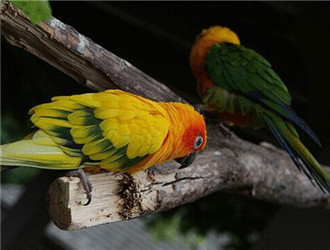
The Jenday Conure’s plumage is predominantly green, with a body length of about 30 cm and a weight of about 133 g. The juvenile’s head color differs from the adult’s; young birds typically have a pale yellow head with some green feathers.
The Jenday Conure’s head and throat are yellow, gradually turning orange toward the upper chest; the crown, forehead, and areas around the eyes are marked with red feathers; the lower belly, sides, and the coverts on the inner side of the wings are orange-red; the feather edges and lower back are red; the greater and lesser coverts are blue, and most of the outer wing feathers are green; the tail is olive-green with a blue tip; there is a ring of white bare skin around the eye; the beak is black, and the iris is gray-brown.
3 Jenday Conure Habitat
In recent years, due to habitat destruction, the Jenday Conure’s numbers in its native range have been decreasing. In many areas the birds can no longer be found. As their wild habitat is destroyed, captive keepers are urged to treat them well.
The Jenday Conure mainly inhabits Brazil’s local vegetation zones, plains with woodland, open areas, and the edges of rainforests. It occasionally visits farmland and has a particular fondness for local coconut plantations. Once common throughout the region, its population has declined greatly due to deforestation and overdevelopment; in many areas the Jenday Conure has disappeared entirely.
4 Jenday Conure Care
The Jenday Conure breeds oviparously, typically from October to January, laying about 3 eggs at a time. It is a classic omnivorous bird; in captivity you will often see it constantly pecking at food, which is very endearing.
In the wild, the Jenday Conure eats natural foods such as seeds, fruit, and berries. Caged birds are quite noisy, especially in the morning and evening, and also when startled or when people are nearby. They are hardy and active, adapt quickly to new weather and environments, and enjoy bathing, so they are not difficult to care for. Provide branches and toys for chewing, and offer various seeds, vegetables, fruit, nuts, grains, boiled eggs, and whole-wheat bread. You may also add an appropriate amount of vitamins to their food or drinking water.
The Jenday Conure’s incubation period is 23 to 26 days; it takes about 50 days for the feathers to develop, and after leaving the nest the young may still be fed by the parents for a while before becoming independent. It differs from the Sun Conure mainly in that its back and wings are green, whereas the adult Sun Conure has green feathers only at the wing tips. The Jenday Conure’s belly color is also deeper, a dark orange-red. It mainly lives in open areas surrounded by rainforest, forest edges, and deciduous forests, usually foraging in groups of around 12, though sometimes in pairs or alone.