Bronze-winged Parrot
2 Photo Gallery

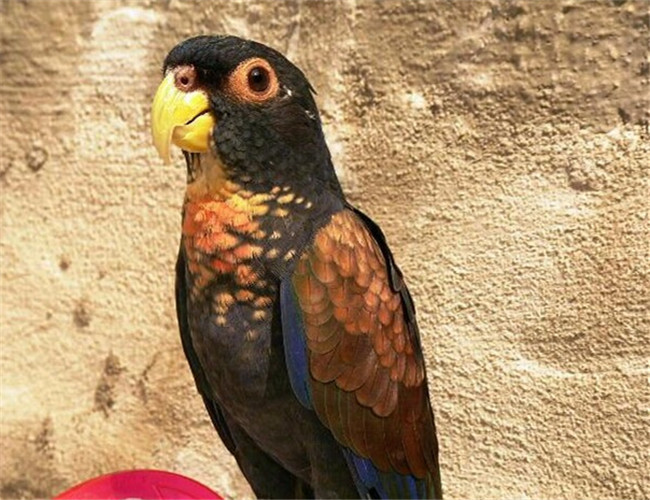
1 Bronze-winged Parrot Breed Overview
The Bronze-winged Parrot, also called the Rainbow Bird, gets its name from its deep blue-purple body color and bronze head and neck; this is the origin of the name Bronze-winged Parrot. It likes to inhabit tropical forests and subtropical forest zones at elevations between 500 and 2000 m.
The Bronze-winged Parrot is mainly distributed in Colombia, Ecuador, Peru, and Venezuela, among other places.
Chinese name: Bronze-winged Parrot
Other Chinese names: Rainbow Bird
English name: Bronze-winged Parrot, Living Rainbow
Binomial: Pionus chalcopterus
Kingdom: Animalia
Phylum: Chordata
Subphylum: Vertebrata
Class: Aves
Subclass: Neornithes
Order: Psittaciformes
Family: Psittacidae
Genus: Pionus
Subspecies: two
Distribution: Andean regions of Colombia, Ecuador, and northwestern Venezuela.
2 Physical Characteristics of the Bronze-winged Parrot
The Bronze-winged Parrot has bare skin around the eyes, which becomes pink in adults. Its body length reaches about 30 cm, with an average lifespan of 10–15 years. The body color is deep blue-purple, and the head and neck are bronze.
The Bronze-winged Parrot’s feather edges carry dark gray-purple; there is a small patch of white feathers on the chin; the throat is marked with dark pink feathers; the back, tail, and shoulder feathers are dark bronze-green with blue edging; the chest and lower belly are dark green with deep blue-purple edges; the wing coverts are bronze, and the primary flight feathers and greater coverts are blue-purple; the inner tail coverts are red; the beak is wax-yellow, and the iris is dark brown.
3 Bronze-winged Parrot Habitat
To keep a Bronze-winged Parrot well, first ensure you have love, care, and patience, because in the early stage of keeping a parrot you have a lot to do, both its diet and living environment requiring your hands-on effort. Let’s look at the details below.
First, a quiet and suitable environment, appropriate temperature, and sufficiently rich and nutritious food. Then the parrot feels safe, becomes lively, and develops the desire to breed. The bird is naturally well kept. A parrot’s heat tolerance is far higher than a human’s; although they can tolerate heat, they cannot tolerate humidity. Many bird lovers keep parrots at home.
In the wild the Bronze-winged Parrot mainly inhabits tropical forests and subtropical forest zones between 500 and 2000 m, and sometimes appears at slightly higher or lower latitudes; it periodically visits cleared or logged woodland. During the breeding season it is usually in pairs or small groups; it is cautious and timid and cannot be approached for observation. When resting in trees it is hard to detect because its plumage provides good camouflage; it is quite quiet while feeding, but quite noisy when flying together to the roost or setting off for a foraging area.
4 Bronze-winged Parrot Care
Bronze-winged Parrot (details)
In the wild the Bronze-winged Parrot mainly eats crops farmers worked hard to grow, such as fruit, nuts, berries, seeds, and tree flowers, so many farmers see it as a pest. As a parrot its talking ability is not great, but that does not affect fans of the Bronze-winged Parrot.
Their wild breeding season starts each year in February or April, nesting in dead tree hollows. Rather nervous by nature, they also have fragile respiratory tracts and easily contract fungal diseases caused by mold; during this period they need more vitamin A. The Bronze-winged Parrot lays 4 to 5 eggs at a time, usually the female starts incubating after the 2nd egg, with an incubation period of about 26 days; the chicks’ feathers develop in about 60 days, and hand-reared Bronze-winged Parrot chicks have a longer weaning period than other members of the genus.