Search Results
183 results for “Male trait”
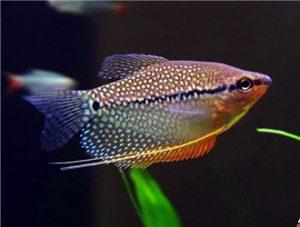
Pearl Gourami
The Pearl Gourami is a common ornamental fish, named for pearl-like spots covering its body and fin edges. Its stately look makes it popular with aquarists.

Paucis Dwarf Cichlid
The Paucis dwarf cichlid was earlier called the blue lyretail dwarf cichlid, later renamed from a foreign translation. Males show a bright pale-blue metallic sheen, very pretty, but both keeping and breeding are very hard.

Mosquitofish
The mosquitofish is mainly from the southern United States and northern Mexico and has spread into lowland waters south of the Yangtze. It feeds mainly on small invertebrates and mosquitoes, hence the name.
Double-banded Dwarf Cichlid
The double-banded dwarf cichlid was first found in 1906; in the wild it lives among layers of fallen leaves in the rainforest, so keep it with black-water treatment. It is fairly easy to keep, needing only stable water and temperature.

Checkerboard Barb
As a juvenile the checkerboard barb has irregular black spots on its side that look like pieces on a chessboard, hence the name. It is easy to keep, lively, and can be mixed with small fish.

Blue Ram Cichlid
The blue ram cichlid is a gentle but rather shy tropical fish; keep it with plenty of plants for cover. Because the male's dorsal fin looks like a saddle, it is also called the seven-color saddle fish.
Red-lined Dwarf Cichlid
The red-lined dwarf cichlid is a dwarf cichlid famous for its red color, and it is fairly simple to keep with no special demands. It was named by Dr. Sven Kullander in 1979.
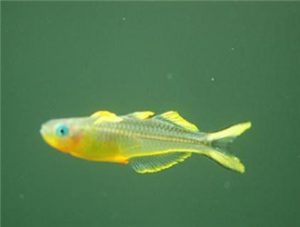
Forktail Blue-eye
The forktail blue-eye is a small rainbowfish with a pale blue-green, semi-transparent body that looks beautiful swimming in the aquarium, so it costs more than other rainbowfish.

Rosy Barb
The rosy barb is native to India. In the aquarium it reaches 5 to 7 cm, but in the wild it can grow to 14 to 15 cm. During breeding it shows a striking rosy-red nuptial coloration.

Pike Cichlid
The pike cichlid is native to the Amazon River basin in South America. It is greenish-cyan with a pointed head and a short but long dorsal fin, and its aggressive temperament means it must never be kept with small ornamental fish.