Pearl Gourami
2 Photo Gallery
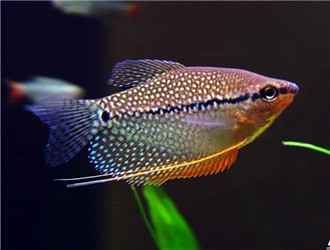

1 Breed Profile
The Pearl Gourami is a common ornamental fish, named for pearl-like spots covering its body and even fin edges. Its stately look makes it popular.
Chinese name: Pearl Gourami
Binomial: Trichogaster leeri
Also known as: Pearl Fish, Mosaic Gourami, Pearl Threadfin, Lace Gourami, Leeri Gourami
Kingdom: Animalia
Distribution: Malay Peninsula, Asia
English name: Trichogaster Seeri
Origin: Thailand, Malaysia and Indonesia
Fish type: ornamental fish
Length: 10 cm
Shape: fusiform
Base color: silver-gray, red
2 Appearance
Adult 10-13 cm, body oval. Covered with pearl spots, stately, popular.
Upper dark, lower light; small dorsal and very developed anal fin, like a trailing gown. Whole body silver dots, elegant, with two long barbels, very pretty. A black round-spot stripe runs from mouth to caudal base along the lateral line on each side. The pelvic fins evolved into thin, long, golden filamentous barbels that sway, like a blind person’s cane, very sensitive.
Adult about 12 cm, covered with fine silver spots; a black line from snout through the eye to the caudal base; the anal fin is long and wide, 2/3 of body length, with shimmering spots; pelvic fins are thoracic and evolved into long filaments (a key trait), flexible, tactile, sensing food. Males have yellow to orange-red from chest to snout, vivid in breeding, very beautiful; females duller.
3 Husbandry
Not hard; adaptable. Using its labyrinth organ to breathe air, it tolerates poor water. Originally in plant-rich waters; 20-30 C, optimal 24-28 C, pH 6.5-8.5, hardness 3-20 dGH. Gentle, especially females; males may attack females after spawning, but males rarely fight otherwise.
4 Feeding
A common tropical fish, easy and pretty, popular. How to feed scientifically?
Newly free-swimming fry are tiny, under 4 mm; lack of suitable food hurts survival. Mouth too small for artemia nauplii; need smaller rotifers. Without rotifers, use egg-yolk water or self-cultured ciliates, but less ideal.
Fry over 1.5 cm can take small daphnia sieved through 30-mesh cloth; later unsieved; or dry food with over 35% animal protein. The Pearl Gourami is less eager to eat than the Blue Gourami and grows slower.