Mosquitofish
2 Photo Gallery

1 Species Overview
The mosquitofish is mainly from the southern United States and northern Mexico and has spread into lowland waters south of the Yangtze. It feeds mainly on small invertebrates and mosquitoes, hence the name.
Chinese name: Mosquitofish
Binomial: Gambusia affinis
Class: Actinopterygii
Family: Poeciliidae
Species: Mosquitofish Gambusia affinis
Also known as: Guppy killer, big-belly fish, hill-stream fish, etc.
Phylum: Chordata
Order: Cyprinodontiformes
Genus: Gambusia
Distribution: Southern USA and northern Mexico; south of the Yangtze (including Taiwan)
2 Appearance and Physical Traits
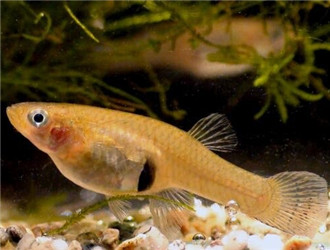
Telling males from females is easy: the male’s anal fin becomes a gonopodium, and males are smaller and more colorful than females. The mosquitofish is small with a distinctive shape.
The mosquitofish is a poeciliid. Elongate, slightly compressed, only 15.5 to 37.5 mm long. Males slightly slender; females with a rounded convex belly. Head wide and short, front flat. Snout short. Large eyes, wide flat interorbital. Small superior mouth, horizontal slit. Fine teeth. Head and body covered with cycloid scales. No lateral line. Male anal fin rays 3 to 5 elongated into a gonopodium. Caudal fin rounded. Native to the southeastern USA, Mexico, and Cuba; moved to some countries for its role in killing malaria-mosquito larvae. Introduced to China in 1935. A small freshwater fish. Likes the surface of slow or flowing water. Females usually larger than males. Live-bearing; fry swim actively at birth, about 5 mm. Fry eat rotifers. Adults eat mosquito larvae and are natural enemies of mosquitoes. Also an ornamental fish, no food value. Max length 50 mm. Live-bearing; fry swim freely at birth. No food value; strong mosquito-larva eating; used for mosquito control. Native to North America, introduced to China in the 1930s, now in southern waters.
The mosquitofish looks like a willow twig, hence the name willow fish. It has a long wide caudal peduncle, compressed body, 2.5 to 5 cm long, wide head, pointed snout, large eyes, fine teeth, no barbels. Males are brightly colored. A warm-water small fish native to North America, introduced to China from the Philippines in 1924 and released in Hangzhou West Lake, later in Guangdong. Popular for its clear mosquito-control effect.
3 Habitat and Living Environment
The adult mosquitofish is 2.5 to 5 cm, so a suitable tank is needed. It is a warm-temperate bottom-dwelling marine fish that in the wild likes waters 15 to 70 m deep.
The mosquitofish was introduced to Taiwan in 1911 and inland in 1924, naturally breeding in many provinces. It is not demanding about temperature or water; best 10 to 30 C, neutral water. It lives over mud or muddy-sand bottoms, sinking by day and rising at night, liking small scattered groups, not large schools. It is a small regional migrant; spawning groups gather relatively.
4 Feeding Guidelines
The mosquitofish, as the name says, eats mosquitoes, but lately it has been found to threaten some medaka. It is a carnivorous ornamental fish that in the wild eats small fish, copepods, and decapods.
The mosquitofish, as the name says, eats mosquitoes—over 200 a day. Because it controls pests and disease, it has settled in many countries. Mistakenly thought to love mosquito larvae and prevent malaria, it was widely introduced worldwide; from the Philippines to China in 1927. In Hong Kong, authorities still release it as a malaria biocontrol tool. In fact many studies show it does not especially prefer larvae, and its larva-eating ability is no stronger than local similar fish.