Gouldian Finch
2 Photo Gallery
1 Species Overview
The Gouldian finch (Erythrura gouldiae) is native to Australia, and as its name suggests it is a strikingly beautiful bird. Its brilliant, multicolored plumage is dazzling and it is especially loved by many young keepers.
Because of human disturbance, the Gouldian finch’s wild habitat has shrunk, and wild populations are now listed as a conservation species. The bird belongs to the waxbill and finch family (Estrildidae), the same family as the commonly kept zebra finch, with a body size between that of a siskin and a sparrow.
Taxonomy: Chinese name Qi Cai Wen Niao; aliases Hu Jin Niao (brocade bird), Wu Cai Wen Niao, Qi Cai Fu Rong; binomial Erythrura gouldiae; kingdom Animalia; phylum Chordata; subphylum Vertebrata; class Aves; order Passeriformes; family Estrildidae (waxbills and finches); genus Erythrura.
Distribution: Australia.
2 Physical Characteristics
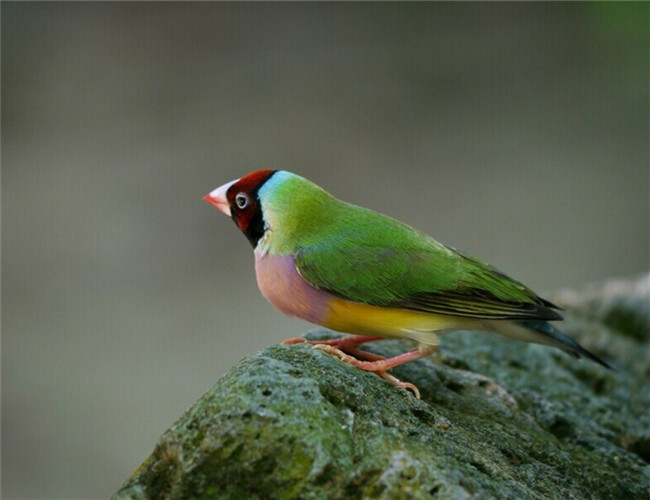
The Gouldian finch’s most typical feature is its rainbow-colored plumage. An adult ideally measures 11 to 14 cm in body length and has a long, forked tail like a swallow.
Its feather colors are extremely vivid, with yellow, red, blue, purple, black, green and intermediate tones. Common head-color forms are red-headed, black-headed and yellow-headed. Males are more brightly colored, with deeper purple on the chest and a longer body; females are duller, with paler chests and slightly shorter tails. Nestlings cannot easily be sexed. More than 20 color varieties have been developed in captivity, of which the red-headed, black-headed and yellow-headed forms are most common.
3 Habitat and Environment
The Gouldian finch prefers dry over humid conditions and likes warmth; it is a flying ornamental bird. In the wild it inhabits open woodland, grassland edges, and areas near villages and farmland. For home keeping the following setup is recommended.
A canary cage can be used as the display cage, or a custom nickel- or chrome-plated metal cage hung in the living room for an elegant look. Gouldian finches are mostly kept in pairs; they adapt poorly and are not cold-hardy, so a box-style cage should be used for breeding, measuring about 45 x 40 x 40 cm. Except for the front, the other sides should be covered with cloth or plastic film, and the top shaded. Fit two perches inside, one near the artificial nest. The nest is a woven grass-ball nest, which should be on the larger side; nesting material is fine grass stems and leaves placed on the cage floor for the birds to carry freely, and the nest is best placed in a dim corner. Prepare several food cups and feed the staple and supplementary diets in separate cups. The finch is not cold-hardy, so the ambient temperature should be kept above 20 degrees C. Give a bath every other day, and clean and disinfect the cage, feeders, waterers and perches once or twice a week. Change the drinking water daily and promptly remove soiled leftover food, keeping the bird in a place with fresh air and ample light.
4 Keeping and Breeding
The breeding season usually runs from December to April. During breeding the diet matters a great deal: feed egg-millet to encourage early mating condition. After both parents build the nest, the male tends to stay inside it while the female enters and leaves frequently, which signals mating readiness. The parents usually mate inside the nest and this is hard to observe; the temperature at this stage should be about 20 degrees C, and if the room cannot reach it, use a heat lamp. Outside the breeding season, what should the Gouldian finch be fed?