Lark (Bailing)
2 Photo Gallery
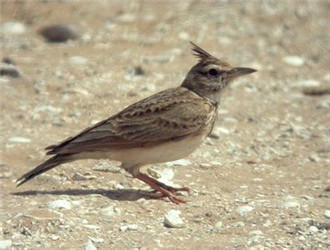
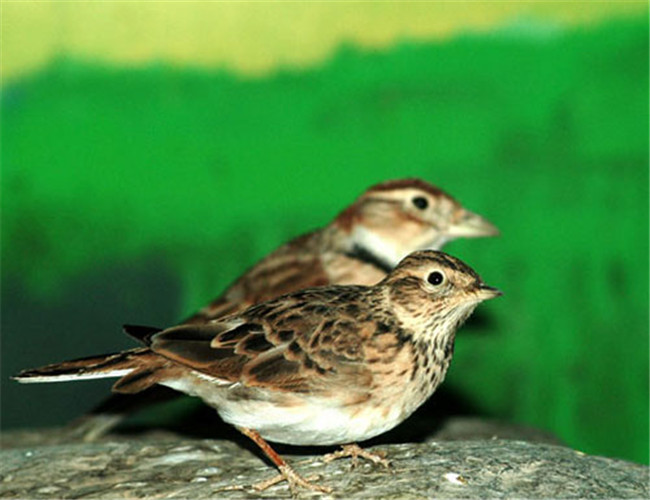
1 Species Overview
The lark is the representative bird of the grassland, a small songbird. It has a pretty crest on its head and a small, conical bill, some species long and slightly curved. On the vast grassland under blue sky and white clouds it performs wave upon wave of beautiful music that even musicians struggle to score, the love songs of the larks. When it rises from the ground it often sings as it flies, so high that one hears it but cannot see it. The lark is now listed as a Class II protected animal in China. Having co-evolved with the grassland over millions of years, it gained traits suited to open plains. Pairs form in late March, singing from the ground and choosing a nest area; the pair dances aloft, shooting straight up into the clouds and hovering dozens of meters high, then dropping vertically when the song stops and rising again to sing.
Taxonomy: Chinese name Bai Ling Niao; kingdom Animalia; phylum Chordata; subphylum Vertebrata; class Aves; order Passeriformes; family Alaudidae (larks); genus Melanocorypha (typical larks); species the lark group (e.g., Mongolian lark Melanocorypha mongolica).
Distribution: mainly Inner Mongolia, Hebei and Qinghai, China.
2 Physical Characteristics
The lark has a pretty crest, a small conical bill, some species long and slightly curved, with often a feather covering the nostril. The wings are slightly pointed and long, the tail shorter than the wing, the hind tarsus edge rounded with shield-like scales, and the hind claw long and straight. Common Chinese kinds include the sand lark, skylark, horned lark, lesser sand lark, steppe lark, wood lark and Mongolian lark. The sand lark and skylark can shoot straight up from the ground into the clouds, balancing up, down, forward and back in the air and hovering on a point to sing.
3 Conservation and Keeping Note
Important: the source states the lark is now a Class II protected animal in China. Wild capture, trade and keeping of protected larks are restricted by law, so prospective keepers should verify the legal status and source of any bird and prefer captive-bred individuals from legal channels.
As a ground-dwelling open-country bird, the lark’s care should respect its habits; a suitable cage and proper seed-based diet matter, and the bird should not be kept under conditions that cause stress. The source’s own keeping advice is limited, so follow general lark husbandry guidance.
4 Cage and Environment
The lark is an ornamental bird, and its cage is like its clothing; a fine cage raises its status and appeal, but it must also be practical, chosen by the lark’s habits. Food and water cups should be deep rather than large, usually half-cylindrical or inverted pyramid in shape.
5 Feeding and Taming
To tame it, offer animal foods like insect larvae, locusts and grasshoppers by hand. To build the habit of singing on the perch, ring the perch with a cardboard collar slightly higher than the cage floor, and use a droppings stick to nudge its feet onto the perch, or frequently feed ‘live food’ on the perch.