African Grey Parrot
2 Photo Gallery
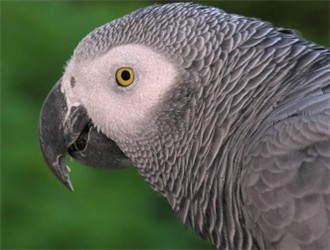

1 Species Overview
The African grey parrot is a large parrot and a typical perching bird. It is one of the few known animals that can truly converse with humans, so its fame is very high.
Taxonomy: Chinese name Fei Zhou Hui Ying Wu; aliases grey parrot, grey; binomial Psittacus erithacus; kingdom Animalia; phylum Chordata; class Aves; order Psittaciformes; family Psittacidae; tribe African parrots; genus Psittacus; species Psittacus erithacus; 2 subspecies; named by Linnaeus, 1758. English names Grey Parrot, African Grey Parrot.
Distribution: Africa.
2 Physical Characteristics
The African grey parrot has strong talking ability and is one of the few animals known to truly talk with humans; gifted and highly intelligent, hence its fame.
It is 33 to 41 cm long, 480 to 560 g, with an average lifespan around 50 years. A large parrot with a short tail and round head, long facial feathers, fond of climbing and a poor flier. The body is grey in varying shades, with a narrow white bare patch around the eye; head and neck feathers have light-grey edges, belly feathers darker edges; main flight feathers grey-black; tail bright red; bill black; iris yellow. The juvenile’s tail tip is black and iris light grey, turning yellow with age. Birds from Nigeria tend to be darker.
Sexing: the male has a broader head with almond-shaped eye corners, the female a narrower head and rounder eye-ring. Two subspecies: the nominate African grey (Psittacus erithacus erithacus) has silver-grey feathers, bright red tail and black bill; the Timneh grey (Psittacus erithacus timneh) looks nearly the same but is clearly smaller, with darker silver feathers, maroon (reddish-brown) tail and a pinkish-flesh bill, more lively and less shy, with talking ability on par with the nominate form.
3 Habitat and Environment
The African grey is a beloved parrot and one of the few animals that can truly talk with humans; parrots have been kept as pets longer than dogs and cats. What environmental points matter?
Newly imported adult greys, especially wild-caught, are usually very tense and uneasy, anxious and slow to adapt, needing a long time to settle. They are among the quieter medium-large parrots and won’t be noisy if not disturbed, but the grey is also among the medium-large parrots most prone to feather-plucking; boredom, anxiety, lack of attention, cramped space, stress and poor nutrition can all cause feather-plucking syndrome, so owners should watch and care closely. Use a sturdy metal cage with enough room to move, and provide various toys to satisfy curiosity and pass time, reducing cage restlessness and preventing feather-chewing.
4 Feeding Highlights
The African grey is among the best-known pet birds, mainly from Africa; as a large parrot, what it eats matters greatly.
Provide a balanced mix of vegetables, fruit, seeds, nuts and grains, with calcium intake especially important; add vitamin supplements in daily life. Besides balanced nutrition, calcium is vital. Greys are jealous, shy and want attention; long neglect, boredom or depression easily leads to the psychological feather-plucking disorder, so give plenty of toys and enough time with them.