Crested Myna
2 Photo Gallery

1 Species Overview
The crested myna is one of China’s common ornamental birds and one of the country’s unique cage birds. Since ancient times it amused nobles, appearing in many literary and historical records. Today, loved for its intelligence and distinctive all-black look, more and more people keep it as a pet. According to the Encyclopedia of China, the male lives about 8 to 10 years and the female 10 to 12; wild birds live 1 to 2 years shorter than caged ones. Records say a female kept by a Tang-dynasty household lived an exceptional 22 years.
Taxonomy: Chinese name Ba Ge; aliases Qiu Yu, Ge Yu, Han Gao, Jia Ling, crested myna; binomial Acridotheres cristatellus; kingdom Animalia; phylum Chordata; subphylum Vertebrata; class Aves; order Passeriformes; suborder Passeri (songbirds); family Sturnidae (starlings); genus Acridotheres; species Acridotheres cristatellus.
Distribution: from southern Shaanxi to all provinces south of the Yangtze, and Taiwan and Hainan.
2 Physical Characteristics
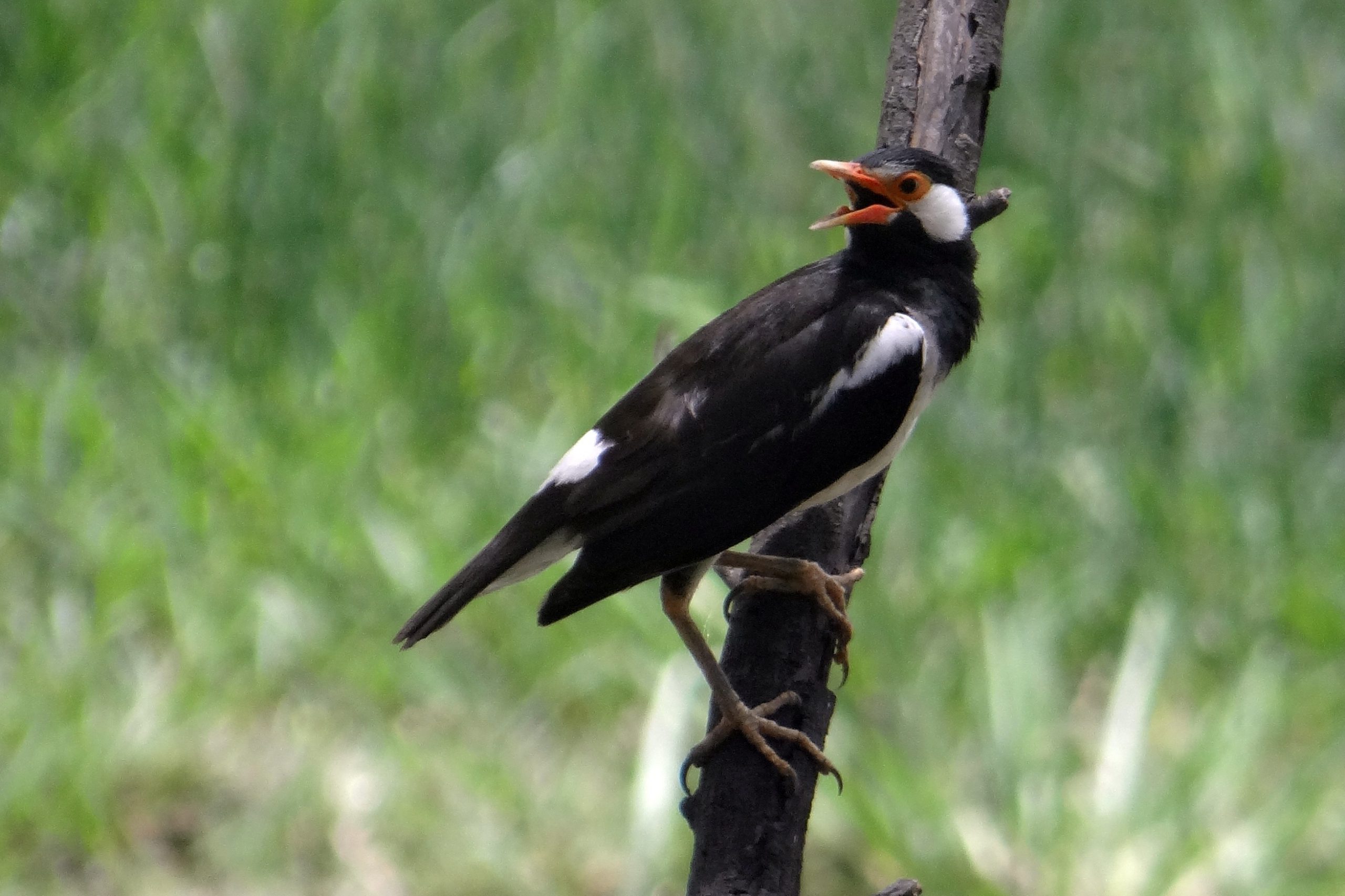
The crested myna is all black and at a glance resembles a crow, but differs markedly. The best birds are males with yellow bill and feet, white tail tips, fully white undertail coverts and glossy black plumage. The finest are bold, songful, standing chest-out with wings spread and large in size. The myna is far smaller than any crow (the large-billed crow is 50 cm; the myna 25 cm), and its bill and feet are bright yellow.
At the bill-to-head junction it has a clear frontal crest; the head and neck feathers show a green metallic sheen, and the primary coverts and bases of the primaries are white, so in flight two central white wing patches form a clear figure-eight from below, the origin of the name ‘ba ge’ (eight), a key ID feature against the black body; the tail tip is white.
The subadult has an underdeveloped crest and less mature, slightly coffee-colored plumage; the nestling iris is blue-grey, turning orange-yellow after about 45 days.
3 Daily Care and Training
The crested myna has been a court pet bird since ancient times and is very popular in China, even exported abroad. Its mimicry is strong; with a little training it can imitate many animal calls and even learn to speak. Smart and unafraid of people, it needs attention to taming.
Bathing: do not bathe very young mynas, whose resistance is weak and who easily catch colds. They preen themselves, so frequent bathing is unnecessary, but a thorough bath when dirty is fine. Best practice: on a sunny day, shade the cage and avoid overheating or dehydration, then place the bird in a basin of warm (not ice-cold) water; it will splash itself, with you assisting. After about 10 minutes, dry it with a towel or a hairdryer.
Training to speak: 1. Start from the fledgling; let it out of the cage about 15 minutes at a time with food nearby, repeating until it flies reliably, which secures the reflex. Reward with insects in the cage. 2. Time: early morning is best, when the bird is most vocal and not yet full. 3. Environment: quiet, no noise or chatter that distracts or teaches wrong sounds; teach indoors. 4. Content: start with short phrases like ‘hello’, ‘welcome’, ‘bye-bye’, ‘thanks’; speak clearly, slowly and in standard Mandarin, not dialect; repeat daily and consolidate, and never let it hear silly or improper words during the sensitive learning window.
4 Cage and Home Environment
The myna is fairly easy to keep, loved for mimicry. It is graceful; sex is told by song, the male’s call bright and rousing, the female’s low and less pleasant. Wild mynas live in woods, plains and villages, so respect those habits at home to avoid stress from sudden change.
Cage: the myna is a large cage bird, so use a bigger cage. Being omnivorous, big-eating and heavy-defecating, use a bright-bottom cage with a droppings tray. Its strong bill and sturdy body need a solid cage; fit one shark-skin perch, deeper and sturdier food and water cups and a soft-food cup. Note mynas cannot tolerate other birds in the same cage, so keep them separately to avoid fighting.
Environment: mynas like quiet; in cold winters keep them warm and cover the cage when walking them outside. Each morning hang the cage by a window or outdoors for 1 to 1.5 hours of fresh air, then bring it back inside.
5 Feeding Requirements
Match the feed to the myna’s growth stage and season. Nine practical points: 1. Fledgling soft food: chick feed half a jin, 4 eggs, 5 crushed yeast tablets, with fish or meat powder reducing the eggs; mix to porridge, refrigerate and use within a week; feed often, especially a full meal at night, and add cuttlebone powder or calcium from day 10. 2. Weaning feed: like fledgling plus chopped greens or fruit (tomato paste is convenient), blending eggs in three stages so the mix does not crumble. 3. Daily feed: one jin chick feed, 1 egg, 5 crushed yeast tablets, moderate cuttlebone powder. 4. Molting feed: early phase chick feed only, reduced, 4 to 7 days; mid phase more eggs (2 to 4) and doubled cuttlebone plus 2 liang peanut powder; late phase taper back to daily feed. 5. Late-autumn and winter feed: like daily but one extra egg and a little oil (1 liang per jin) or 2 liang peanut powder. 6. Fruit and vegetables: greens like cabbage and radish far exceed fruit in vitamin C; fresh vegetables are better than stored fruit. 7. Micronutrients: the mixed feed meets needs; just crush eggshell in, no extra vitamins needed. 8. Keep adding yeast tablets (dry yeast) for digestion and to help absorb fat-soluble vitamins. 9. Grit: keep sand in the cage for the bird to take freely, aiding nutrient absorption in confined birds.