Search Results
4113 results for “ear pH”

Chameleon
Even if you have never kept a chameleon, you have surely heard that it can change color. Chameleons change color mainly for self-defense, but what physiological traits cause this? And did you know a chameleon's color can also reflect its mood?

Rose-ringed Parakeet
The Rose-ringed Parakeet, also known as the Ring-necked Parakeet, is cautious about both diet and activity, and newly imported chicks are especially wary of people. With proper care it can live around 30 years.

White-fronted Amazon
The White-fronted Amazon (Amazona albifrons) is a small parrot also known as the White-browed Amazon, native to Mexico and Central America. With its white forehead patch, lively nature, and strong chewing instinct, it makes a striking pet, though it is a moderately to very noisy species that needs dietary care during acclimation.
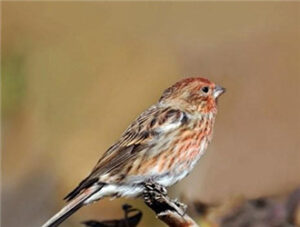
Pallas’s Rosefinch
The Pallas's Rosefinch does not breed in China. During autumn migration some adults and subadults winter in China and depart the following spring. The Pallas's Rosefinch (Carpodacus roseus), also called 'Kaoshanhong,' belongs to the order Passeriformes and family Fringillidae. In China it is a winter visitor, seen in late autumn and winter in the Northeast, Shandong, Shanxi, Henan, Shaanxi, Gansu, and Jiangsu. With beautiful plumage and sweet song, it is easy to keep and tame, one of the most common cage birds in China. But its red feathers fade easily in captivity, how to prevent fading remains to be explored. It generally inhabits mountainous mixed coniferous-broadleaf forests, broad-leaved forests, and hilly mixed woods, also plain elm-willow woods, usually at low elevations. The type locality is Udam, Siberia.
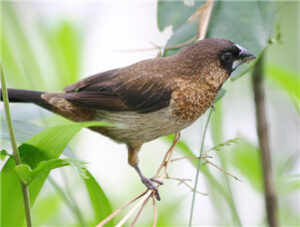
White-rumped Munia
In old times, street fortune-tellers often carried caged birds that would pick out prophecy slips, calling them 'magic sparrows' to deceive people. That 'magic sparrow' was the White-rumped Munia, a seed-eating bird that is bold and tame and easy to keep in a cage.

Chinese Bulbul
The Chinese Bulbul (Pycnonotus sinensis) is a small passerine bird of the family Pycnonotidae. Its forehead to crown is black, with white above the eyes extending to the nape, forming a white nape ring, and a white belly with yellow-green streaks. Lively, it flocks in fruit trees and sometimes sallies from a perch to catch insects. Common south of the Yangtze, it lives in hills or plains shrubbery and coniferous forests. Lively and not very afraid of people. Omnivorous, eating both animals and plants. It eats many agricultural and forestry pests and is a beneficial bird worth protecting.
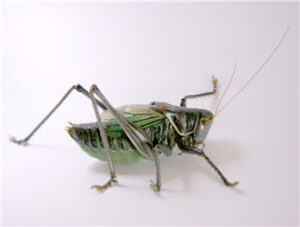
Tettigoniidae
The Katydid (Tettigoniidae) is known as the 'king of singing insects,' generally referring to the loud-singing male katydids of the family Tettigoniidae, including the Chinese bush cricket. The male has a sound organ near the forewings and produces sound by rubbing the two wings together. Aliases include Guoguo, Zhongsi, Youzi, and Jiaoying.
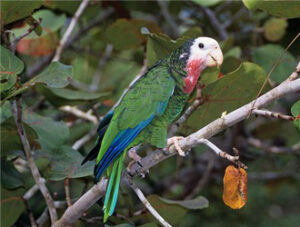
Cuban Parrot
The Cuban Parrot is a typical perching bird, listed under CITES Appendix I, a critically endangered first-class protected parrot. It has 4 subspecies, mainly distributed in mountain forests and low-latitude woodland.

Princess Parrot
The Princess Parrot is among the most elegant and beautiful of all Australian long-tailed parrots, and its refined looks are loved by many. It is mainly distributed in the inland regions of central and western Australia.
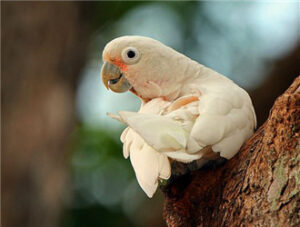
Tanimbar Corella
The Tanimbar Corella is among the smallest white cockatoos, so its looks are very lovable. Among cockatoos, the Tanimbar Corella has one of the best talking abilities; it is very smart and easily learns many tricks and skills.