Pallas’s Rosefinch
2 Photo Gallery
1 Pallas’s Rosefinch Breed Overview
The Pallas’s Rosefinch does not breed in China. During autumn migration some adults and subadults winter in China and depart the following spring. The Pallas’s Rosefinch (Carpodacus roseus), also called ‘Kaoshanhong,’ belongs to the order Passeriformes and family Fringillidae. In China it is a winter visitor, seen in late autumn and winter in the Northeast, Shandong, Shanxi, Henan, Shaanxi, Gansu, and Jiangsu. With beautiful plumage and sweet song, it is easy to keep and tame, one of the most common cage birds in China. But its red feathers fade easily in captivity, how to prevent fading remains to be explored. It generally inhabits mountainous mixed coniferous-broadleaf forests, broad-leaved forests, and hilly mixed woods, also plain elm-willow woods, usually at low elevations. The type locality is Udam, Siberia.
Chinese Name: Pallas’s Rosefinch
English Name: Pallas’s Rosefinch
Binomial Name: Carpodacus roseus
Kingdom: Animalia
Phylum: Chordata
Class: Aves
Order: Passeriformes
Family: Fringillidae
Genus: Carpodacus
Species: Pallas’s Rosefinch
Distribution: Northeast, Shandong, Shanxi, Henan, Shaanxi, Gansu, Jiangsu
2 Physical Characteristics of the Pallas’s Rosefinch
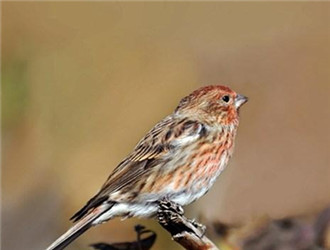
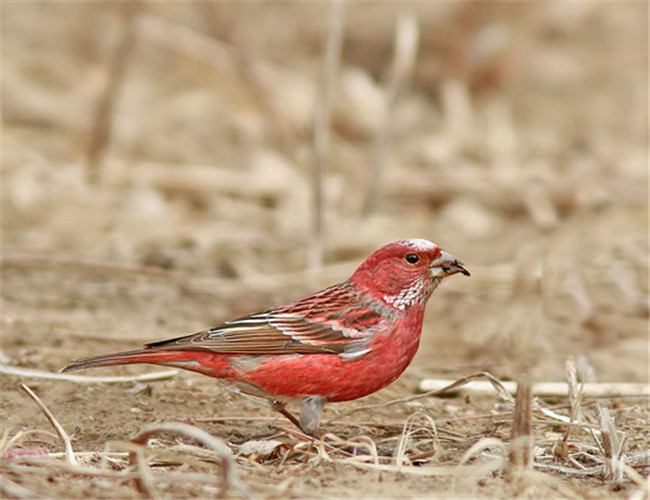
The Pallas’s Rosefinch is a medium-sized (16 cm), rather stocky finch with a slightly long tail. Male: head, lower back, and underparts crimson; crown paler; forehead and chin frosty white; no contrasting eyebrow; upperparts and coverts dark brown with pinkish-white edges; crimson breast, pink belly, two pale wing bars. Female: duller, upperparts with brown streaks, pink forehead and rump, buff underparts streaked, breast tinged pink, white rump. Iris brown; bill near gray; feet brown. Voice: usually silent; short low whistle; soft, modulated song. It is about 11.5 cm long. The body feathers are mostly pink; the forehead and throat are silver-white scaly feathers; the wings and tail are dark brown edged pink, with two pale pink bars on the wing. The female’s crown and underparts are brown-yellow with black streaks.
The Pallas’s Rosefinch does not breed in China; some adults and immatures winter here during autumn migration and leave in spring. It is gregarious, pecking at wild plant fruits, seeds, and buds, and also grain. A common winter visitor in northern and eastern China, south to Jiangsu and west to Gansu. In winter it can reach 2,500 m elevation. The summer breeding area is higher; it likes coniferous forests but winters in cedar forests and shrub-covered slopes.
3 Pallas’s Rosefinch Care Tips
In winter the Pallas’s Rosefinch migrates to northern China, Japan, Korea, and northern Kazakhstan. An uncommon winter visitor in northern and eastern China, south to Jiangsu and west to Gansu, reaching 2,500 m in winter; the summer breeding area is higher, in coniferous forests, wintering in cedar forests and shrubby slopes. In China it is found in Jilin (Changbai, Laoyeling, Changchun, Liaoyuan), Liaoning (Dandong, Caohekou), Inner Mongolia (Hulunbuir, Greater Khingan, Chifeng), Ningxia (Zhongwei, Yinchuan, Helan Shan), Gansu (eastern Qilian Shan, Sunan, southeastern Tianshui, southwestern Zhuoni, Maqu, Zhouqu), Hebei, Shaanxi, Shanxi, Shandong, Henan, and Jiangsu (Zhenjiang, Shaweshan Island). Keep it in a canary cage or a similar homemade round or square bamboo cage. Feed various grain seeds; mix barnyard grass, broom corn millet, and millet at 6:3:1, or barnyard grass and millet at 7:3, with a little vegetable leaf and fruit, adding perilla in autumn and winter.
The female’s plumage is olive-brown with gray streaks on the chest and flanks and near-white lower belly. The male in breeding plumage is mainly red, with dark brown wings edged slightly red. The Pallas’s Rosefinch has a sweet, melodious song, is easy to tame, and can learn tricks such as free flight, fetching objects, and wearing a mask, making it one of the common ornamental birds kept by the public in China.
4 Pallas’s Rosefinch Living Environment Notes
The Furuong cage, also called a canary or jade-bird cage, suits small granivores such as canaries, white java sparrows, gray java sparrows, silverbill, Pallas’s Rosefinch, zebra finch, red-billed leiothrix, and meadow bunting. The Pallas’s Rosefinch inhabits low-elevation montane mixed coniferous-broadleaf forests, broad-leaved mixed forests, and broad-leaved forests, as well as hilly mixed woods and plain elm-willow woods. It migrates in family flocks, is not very shy of people, and has a loud, sweet song. It eats weed seeds, berries, and leaves. Keep it in a canary cage or similar homemade round or square bamboo cage, feeding various grain seeds; mix barnyard grass, broom corn millet, and millet at 6:3:1, or barnyard grass and millet at 7:3, with a little vegetable and fruit, adding perilla in autumn and winter.
The Pallas’s Rosefinch is beautiful and sweet-singing, easy to keep and tame, one of China’s most common cage birds. But its red feathers fade easily in captivity, how to prevent fading remains to be explored. It does not breed in China; some adults and immatures winter here in autumn and leave the following spring.