Red-rumped Parrot
2 Photo Gallery
1 Red-rumped Parrot Breed Overview
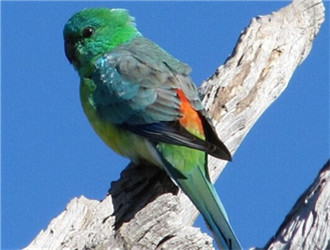
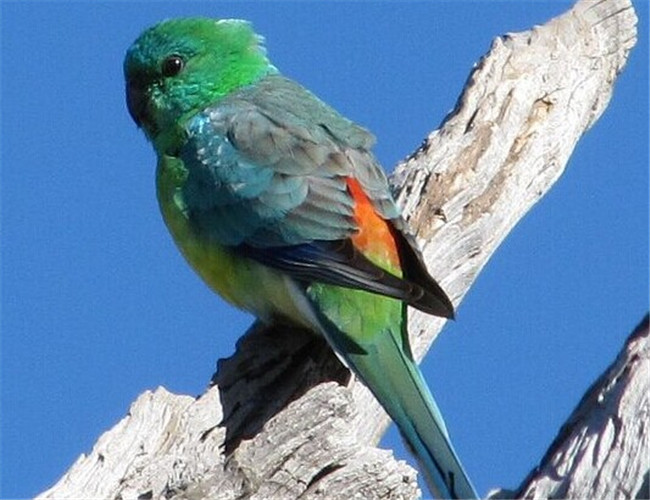
The Red-rumped Parrot (Psephotus haematonotus) looks from a distance like a miniature peacock from behind, with beautifully blended multicolored plumage. This parrot is mainly distributed in southeastern Australia.
Chinese Name: Red-rumped Parrot
Chinese Aliases: Red-rumped Parrot, Red-backed Parrot, Sweet-voiced Parrot
English Name: Red-rumped Parrot
Binomial Name: Psephotus haematonotus
Kingdom: Animalia
Phylum: Chordata
Class: Aves
Order: Psittaciformes
Family: Psittacidae
Tribe: Australasian Parrots
Subspecies: 1
Distribution: Southeastern Australia, except the Cooper’s Creek area; northeastern South Australia and southwestern Queensland
2 Physical Characteristics of the Red-rumped Parrot
Unlike dogs and cats, parrots—especially males and females—are often very hard to tell apart, and most require a professional to identify the sex. But the Red-rumped Parrot can be distinguished by its plumage. Let’s take a closer look at the physical characteristics of the Red-rumped Parrot.
The Red-rumped Parrot is about 27 cm long and weighs 54–70 g. Its head is green; the forehead, front of the crown and area below the cheeks have a bluish tint; the chest is yellow-green; the belly shows obvious yellow; the underside coverts of the tail are white; the neck and back are dark blue-green; the lower back is red; the middle coverts on the outer wing are yellow; the feathers at the wing bend, inner coverts and near the outer primary coverts are blue-purple; the inner middle coverts and secondary flight feathers are blue-green; the inner tail is light blue; the upper tail coverts are green; the beak is grayish-black; the iris is dark brown.
Females are olive-gray; the crown, back and wings are olive-green; the lower back and upper tail coverts are green; the feathers at the wing bend, primary flight feather coverts and nearby feathers are deep blue-purple; the middle coverts on the outer wing are light blue; the inner tail feathers are white with a light blue tint; the beak is gray. Juveniles have the same body color as adults but are darker; young males have a few red feathers on the lower back, and juveniles take about 4 months to develop adult plumage.
3 Red-rumped Parrot Care Tips
Captive Red-rumped Parrots are very active; they are usually quiet and not noisy, and will actively interact with people, making them a very popular pet parrot. They should be dewormed regularly. Red-rumped Parrots mainly inhabit open woodlands, orchards, eucalyptus groves, tropical grasslands, farmland, wooded pastures, and areas around water sources up to about 1,100 m in elevation; they have been found in mangroves on Kangaroo Island, and sometimes appear in parks or gardens.
4 Red-rumped Parrot Feeding Guidelines
Different parrots like different foods, and even parrots of the same species can have different tastes. Although most parrots love grains and seeds, after feeding them for a while you’ll discover which foods they prefer. Below we look at the feeding guidelines for the Red-rumped Parrot.
In the wild they spend several hours a day foraging on the ground, preferring to search for food beneath dense, shady tall trees. They are quite easy to spot in flight, but when perched in dense foliage their plumage provides excellent camouflage, making them hard to detect. Sometimes they visit farms or fields near human settlements to pick up spilled grain. At dawn each day they first go to the ground to drink, then fly to their feeding grounds; in hot or summer weather they may drink several times a day. At midday in the heat they rest in dense shade or shrubs. While foraging on the ground they are not very wary, so they are often preyed upon by raptors or local wild cats.
Red-rumped Parrots mainly eat grass and shrub seeds, ground vegetation, plant shoots, berries, fruit, flowers, insects and their larvae.