Red-fronted Macaw
2 Photo Gallery
1 Red-fronted Macaw Breed Overview
Although the Red-fronted Macaw (Ara rubrogenys) is the smallest of the macaws, its sturdy build is absolutely unmatched by ordinary parrots. This parrot is native to the tropical regions of the Americas, and its wild population is now quite small.
In juvenile Red-fronted Macaws the red feathers on the head are not obvious and gradually increase with age; once mature, the feathers on the head, cheeks and shoulders show a beautiful, vivid orange-red, which is very striking. Its diet consists of many fruits and flowers; it has a large appetite, and its powerful beak can crack open nuts to suck out the flesh with its blunt tongue. It is found in the tropical regions of the Americas, nesting in trees along riverbanks or in holes in cliff walls.
Chinese Name: Red-fronted Macaw
English Name: Red-fronted Macaw
Binomial Name: Ara rubrogenys
Kingdom: Animalia
Phylum: Chordata
Class: Aves
Order: Psittaciformes
Family: Psittacidae
Genus: Ara
Species: Red-fronted Macaw (A. rubrogenys)
Distribution: South America, including Colombia, Venezuela, Guyana, Suriname, Ecuador, Peru, Bolivia, Paraguay, Brazil, Chile, Argentina, Uruguay and the Falkland Islands (also known as the Malvinas).
2 Physical Characteristics of the Red-fronted Macaw
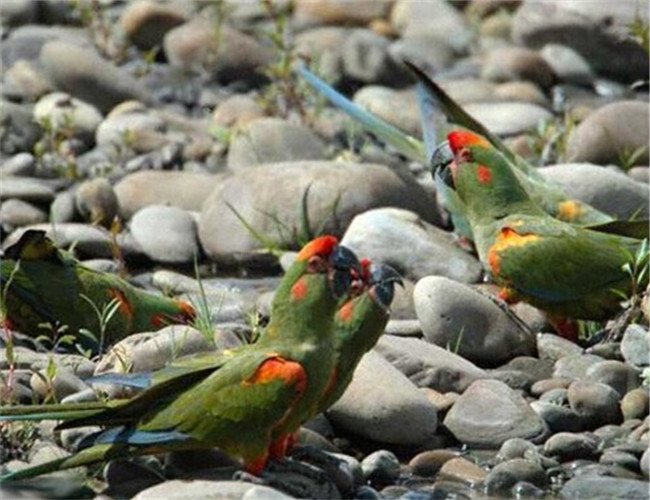
Only a small part of the Red-fronted Macaw’s body is red; the vast majority of its plumage is olive green. An adult Red-fronted Macaw is about 55 cm long. There are red feathers on the forehead, ear coverts and near the thighs, and red feathers are also sparsely distributed on the wings.
At the curved front edge of the wing and on the inner wing coverts there is a small amount of orange-red; most of the inner wing coverts are olive-yellow; the top of the tail is olive green with a bluish tip, and the underside of the tail is olive-yellow; near the face, the white bare skin has several brown-black feathers arranged horizontally, and the beak is black.
3 Red-fronted Macaw Care Tips
In the wild, Red-fronted Macaws usually breed between November and April each year. Captive birds are good at learning to talk and will actively interact with their owners, earning praise from many bird lovers abroad. Because the Red-fronted Macaw entered the aviculture industry relatively late, it naturally lags far behind other species in captive breeding and propagation.
4 Red-fronted Macaw Feeding Guidelines
Red-fronted Macaws like to fly in flocks or pairs in the wild, so to keep the parrot from being lonely, it is recommended to keep them in pairs in captivity. Keeping this parrot requires not only a suitable living environment but also careful daily feeding, which is a key concern.
In the wild, Red-fronted Macaws like to nest in cliffs or small tree hollows, flying to feeding areas at dawn to forage and not returning to the nest until dusk. They are noisy but not shy, and spend a lot of time each day searching for food on the ground—sometimes as much as 4 hours. Locals sometimes call them ‘Loro Burro,’ meaning a very stupid bird, too dumb to speak. Red-fronted Macaws like crops planted by farmers (such as peanuts and corn, which are their staples), as well as various cacti in dry areas, and some wild fruit, berries, nuts and small insects.
They love to chew, so cages and perches must be made of hard materials, and some wood can be provided for them to gnaw. Their diet should still focus on variety and nutritional balance; vegetables, fruit, seeds, nuts, bird biscuits, egg food and vitamin supplements are all good choices.