Red-billed Blue Magpie
2 Photo Gallery

1 Species Overview
The red-billed blue magpie (Urocissa erythrorhyncha) is an elegant cage bird, fairly large, with a red bill and red feet and a very long, beautifully curved tail. The yellow-billed blue magpie looks basically similar except for the bill, which is yellow, and it has only a white patch on the nape; the difference is still clear and easy to tell in the wild.
Taxonomy: Chinese name Hong Zui Lan Que; aliases Chi Wei Shan Ya, Chang Wei Shan Que, Chang Shan Que, Shan Zhe; English name Red-billed Blue Magpie; binomial Urocissa erythrorhyncha; kingdom Animalia; phylum Chordata; subphylum Vertebrata; class Aves; order Passeriformes; family Corvidae (crows); genus Urocissa; species Urocissa erythrorhyncha.
Distribution: Beijing, Hebei, Inner Mongolia, Liaoning, Jiangsu, Jiangxi, Henan, Hunan, Guangdong, Guangxi, Sichuan, Guizhou, Yunnan, Shaanxi, Gansu, Ningxia and Hong Kong.
2 Physical Characteristics
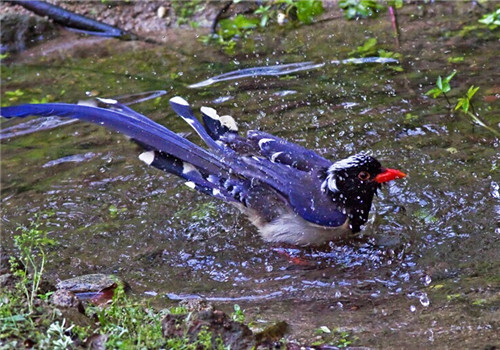
The adult red-billed blue magpie is about 60 cm long; males and females have similar plumage. It is a rather noble cage bird. The body is blue-purple above, with long tail feathers, the central two especially prominent, white at the tail tip, set off by the red bill and red feet, giving it a dignified, stately look, and it is also called the long-tailed blue magpie.
It is a beautiful cage bird with similar male and female plumage. The forehead, crown to nape, head sides, neck sides, chin, throat and upper breast are all black; each feather from crown to nape has a white, blue-white or grey-purple tip, and this tip patch grows larger toward the back, forming a large patch from crown to nape and sometimes to the center of the upper back. The back, shoulders and rump are purple-blue-grey or grey-blue tinged brown; the uppertail coverts pale purple-blue or pale blue-grey with black terminal and white subterminal bars. The tail is long and graduated; the central tail feathers are blue-grey with white tips, the rest purple-blue or blue-grey with white tips and black subterminal bars. The wings are black-brown, the primaries blue-purple at the base on the outer web and white at the tip, the secondaries white-tipped on both webs with blue-purple outer edges. The lower throat and breast are black; the rest of the underparts white, sometimes tinged blue or yellow. The iris is orange-red; the bill and feet are red.
3 Habitat and Environment
Because the red-billed blue magpie’s tail is slender, in captivity a larger cage for display is recommended rather than a small ornamental bamboo cage. The bird is fairly easy to keep and not demanding about its environment.
Some keep it tethered by a cord around the neck on a perch, with good results. The captive diet is mainly egg-rice, with a little oriole mixed powder, raw meat, fruit and greens, and a small amount of insects every day or every other day.
The red-billed blue magpie is very cold-hardy and can spend winter in snow and ice. In ice-free seasons give enough bath water daily for health. In captivity it often hides food, tucking insects or meat into cage crevices for later; clear these promptly to prevent spoilage. At Beijing Zoo from 1954 to 1956, magpies kept in a pheasant aviary nested in a 5 to 6 m pine tree, laid eggs and hatched successfully, rearing 3 young each year for two consecutive years.
4 Feeding Highlights
Like other birds, the red-billed blue magpie loves animal foods such as insects, but also fruit, and is a typical omnivore, easy to keep and an important ornamental bird. Many zoos exhibit it and many individuals keep it. It eats large numbers of pest insects, so it is very beneficial.
Common animal foods include click beetles, chafers, locusts, grasshoppers, flies, katydids, crickets, beetles, lepidopteran larvae and other insects, as well as spiders, snails, worms, fireflies, frogs, lizards, nestlings and eggs, other small invertebrates and vertebrates.
Plant foods are mainly fruits and seeds of various trees and shrubs, occasionally crops such as wheat and corn.