Port Lincoln Parrot
2 Photo Gallery
1 Port Lincoln Parrot Breed Overview
The Port Lincoln Parrot has three subspecies in total. Because of its wide distribution, its habitat is also broad; it is mainly active in open eucalyptus woodland, shrubland, farmland and orchards, coastal areas, desert regions, suburbs, and parks. Populations in northern Australia migrate seasonally.
2 Physical Characteristics of the Port Lincoln Parrot
The different subspecies of the Port Lincoln Parrot vary in size, averaging about 35-44 cm in length and weighing around 165 g. Males are slightly larger than females, with a brown head and patterned underwings. Juveniles have a darker chest, a brown head, a grayish-brown chin, and green at the tail tip. It takes 12-15 months to reach adult plumage.
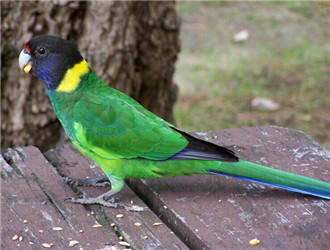
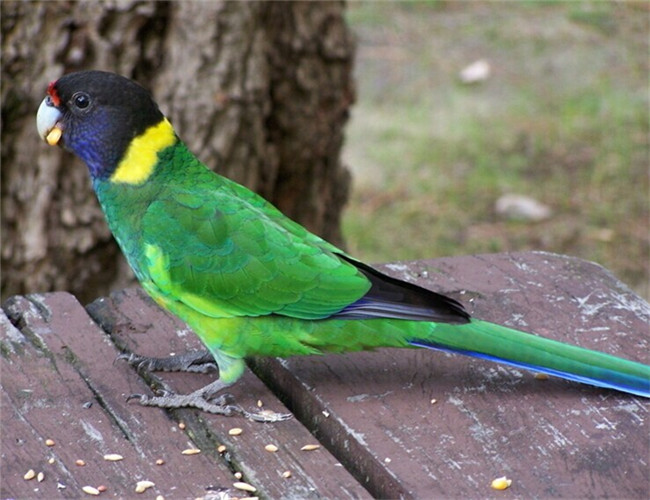
The southwestern subspecies of the Port Lincoln Parrot has the largest bill and body size, with a green belly (unlike the other two subspecies, which have a bright yellow belly). The western subspecies is the smallest, with paler and less vivid coloring. The female’s head and bill are smaller than the male’s, and her plumage is also paler. This parrot has a basically black-brown head and cheeks, with dark blue spots on the coverts below the ear and on both sides of the throat. There is a narrow bright yellow collar on the back of the neck. The upperparts show various green mosaic spots and very fine green striations; the primary flight feathers show more classic blue-green inner edges, while the outermost feathers have pale green outer edges. The bend of the wing is turquoise, the primary coverts are blackish-brown, and the flight feathers are black with a hint of blue. The underparts contrast: the chest feathers are deep green, the upper belly is bright yellow, and the lower belly and undertail are pale yellow, with the middle deep green shot with deep blue. The bases of the outer tail feathers are dark black, the underside of the tail is pale blue, and the tail tip is white. The bill is grayish-white, the iris brown, and the legs gray.
3 Port Lincoln Parrot Habitat
The habitat requirements of the different subspecies of the Port Lincoln Parrot vary, but most inhabit dry regions. Their habitats include open eucalyptus woodland, shrubland, farmland, orchards, coastal areas, desert regions, suburbs, and parks.
Caged Port Lincoln Parrots are very robust and have a strong bite, so it is best to provide a sturdy aviary and nest box, with toys or fresh branches for them to chew. Keeping them in a small cage is far from ideal; they should be housed in a large flight. Because males are quite aggressive, keeping them as pairs is preferable. The nominate and southwestern subspecies are relatively rare in captivity.
4 Port Lincoln Parrot Care
Port Lincoln Parrot (details)
In the wild the Port Lincoln Parrot likes to forage in pairs or flocks and is very noisy. Its diet mainly consists of nectar, grass seeds, fruit, flowers, and insects. Many farmers find the Port Lincoln Parrot quite a nuisance and sometimes shoot them because of crop damage. Populations in northern Australia migrate seasonally.
The Port Lincoln Parrot begins nesting from June to February (earlier for northern populations). It is highly territorial during breeding; the female usually chooses the nest site, mostly in a tall eucalyptus near a water source. A clutch is 5-7 eggs, hatching after about 19 days; for the first week the female feeds the chicks alone, after which the male also joins in. The young leave the nest after about 4 weeks but stay with the parents for a while.
Breeding is not easy, and breeding in a small cage is especially ineffective; success is much greater in a large aviary. To prevent the birds from chewing up the nest box, provide a sturdy box or attach it outside the aviary; a natural hollow log works best. If using a standard nest box, it must be deep enough (at least 70 cm). They reach sexual maturity at about 2 years; breeding too early is not recommended. The breeding season begins in spring but may start earlier; a clutch is usually 4-7 eggs (typically 5), with an incubation period of about 20-22 days. For the first 10-14 days after hatching the female feeds the chicks alone, then the male joins in. The young’s feathers are fully grown at about 5 weeks.