Philippine Hanging Parrot
2 Photo Gallery
1 Philippine Hanging Parrot Breed Overview
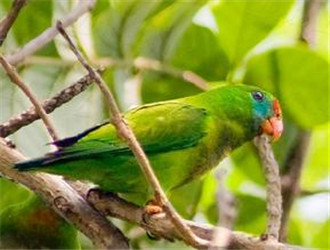
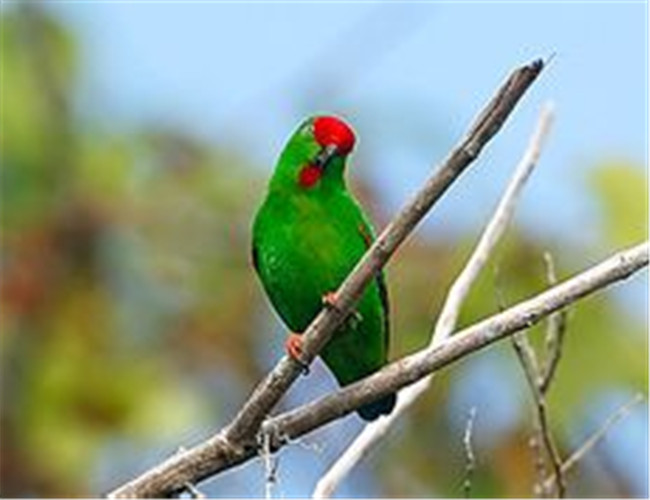
The Philippine Hanging Parrot (also called the Philippine Short-tailed Parrot) is a typical climbing bird. Its plumage is mainly green with a red forehead, usually active in the canopy, and mainly distributed in the Philippines.
Chinese Name: Philippine Short-tailed Parrot
Latin Name: Loriculus philippensis
Aliases: Philippine Hanging Parrot
Kingdom: Animalia
Phylum: Chordata
Class: Aves
Order: Psittaciformes
Family: Psittacidae
Genus: Loriculus
Species: Philippine Short-tailed Parrot
Subspecies: 10
Named by and Year: Muller, 1776
English Name: Philippine Hanging Parrot
English Name: Colasisi
2 Philippine Hanging Parrot Appearance
The Philippine Hanging Parrot is a typical climbing bird; its feet are short but strong, two toes forward and two back, ideal for gripping and climbing. Its plumage is also very vivid and eye-catching.
The Philippine Hanging Parrot is about 13-14 cm long, weighing 31-40 g. It is small and slender with a short tail; the body is mainly green with a red forehead and golden-yellow spots on the neck; the throat and upper breast have a large red patch; the rump and upper tail coverts are bright red; the sides of the rump are turquoise or azure blue. The underside of the wings and tail is pale blue. Females lack the red on the throat and have a red forehead patch and some pale blue around the bill base. Juveniles resemble females with a small red spot on the forehead. The bill is red, the legs and feet gray. There are 10 subspecies, varying in plumage, bill, and feet.
3 Philippine Hanging Parrot Habitat
The Philippine Hanging Parrot is a typical climber, so it is usually active in the canopy, in pairs or small flocks, and may mix with other species. It is mainly distributed in the Philippines.
It likes forest edges, dense woodland, secondary forest, orchards, and coconut plantations. It also appears in bamboo thickets and shrubland near villages and farmland. It usually lives below 1,250 m in plains and lowlands, becoming scattered above that; some are observed up to 2,500 m. It is an arboreal parrot active in the dense canopy.
4 Philippine Hanging Parrot Feeding Guidelines
The Philippine Hanging Parrot is an arboreal parrot and typical climber. In the 2012 IUCN Red List ver 3.1 it is listed as Least Concern (LC), so if you keep one, you can refer to its wild diet.
It is usually active in the canopy but descends lower to find suitable food. It mainly eats nectar and flowers, feeding on fermented coconut nectar in plantations, and also ripe fruit such as figs. Because it likes to hang from branches to rest and play, it is also called the hanging parrot.