Hwamei (Chinese Hwamei)
2 Photo Gallery

1 Species Overview
The hwamei (Garrulax canorus) looks plain; though it lacks brilliant plumage, it has a very loud voice and a melodious, sweet song, and has long been a famous cage bird in China.
The hwamei likes to inhabit shrubs on hills and shrubs or bamboo near villages; it is alert and timid, forages on the ground under cover and does not fly far. During breeding the male hides alone among weeds and branches and sings beautifully and loudly, a noted cage bird. It is omnivorous, feeding mainly on insects, especially in breeding season, and also on grass seeds and wild fruit. It is distributed in Laos, northern Vietnam and the southeast coast of China, and is resident in central and southern China, Hainan and Taiwan. It is the city bird of Guangzhou.
Taxonomy: Chinese name Hua Mei Niao; aliases Hua Mei, Hu Dong, Jin Hua Mei; English name Garrulax canorus; binomial Garrulax canorus (formerly Leucodioptron canorus); kingdom Animalia; phylum Chordata; class Aves; order Passeriformes; family Leiothrichidae (laughingthrushes); genus Garrulax; species Garrulax canorus.
Distribution: across Yunnan and central and southern China.
2 Physical Characteristics
Juvenile and adult hwamei differ clearly in color: the July fledgling has plain brown upperparts without streaks and no barring on the tail, and buff-white downy underparts without streaks or bars; by September it resembles the adult but slightly duller, with dark brown streaks from crown to upper back and from throat to chest.
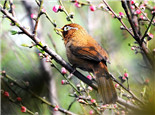
Male and female have similar plumage. The forehead is brown; crown to upper back brown with broad black-brown streaks, darker at the front and paler behind. The white eye-ring extends backward as a narrow line to the neck side, like an eyebrow, giving the name ‘hua mei’ (painted eyebrow; the Taiwan subspecies lacks the stripe). The head sides including lores and ear coverts are dark brown; the rest of the upperparts olive-brown; flight feathers dark brown with brown outer edges; the tail dark brown with several faint dark bars. The chin, throat, upper breast and breast sides are buff with black-brown streaks; the rest of the underparts buff, the flanks darker without streaks, the belly center greyish, the vent tinged brown.
The body is slender, spindle-shaped, streamlined. The upperparts are olive, the lower belly greenish-brown or yellowish-brown, a small central lower-belly patch grey-white without markings; head, chest, neck and tail feathers are darker with black streaks or bars. The white eye-ring and the white ‘eyebrow’ extending front to back in a moth-like curve are especially pretty, hence the name.
At the front of the head is a horny beak used for pecking, preening, fighting and singing; about 20 to 25 mm long, the upper mandible slightly longer. The upper beak horn is dark brown-black, larger; the lower smaller and paler, with nostrils at its upper rear. Long black vibrissae (‘whiskers’) grow near the forehead.
The eyelids are round; the eye color varies with visual pigments, giving brilliant ‘eye sand’. A nictitating membrane protects the eye in flight. Behind each eye is a bean-sized ear opening with ear feathers to gather sound. The wings are long, the primaries covering from chest to back, about 75 mm; spread width 90 to 110 mm each side. The only skin gland is the uropygial (preen) gland at the tail base, secreting oil to keep feathers from deforming and water-resistant. The feet are pale yellow-brown, the tarsus about 40 mm.
3 Keeping Tips
Countless people keep hwamei, but few use truly scientific methods. Key practical tips:
1. Clean the cage and cage cover often, about every 3 days; a lazy keeper never raises a bird well. 2. Play with any bird you like, don’t over-fixate on a ‘grand’ appearance. 3. Beginners should start with a lesser bird to practice, then buy a good one later. 4. There is no bird that will not sing; it depends on your patience and method. 5. Feed ratio: more plant than animal, about one-third animal, two-thirds vegetable. 6. Judge food softness and the bird’s health from its droppings. 7. Greens and fruit adjust feed softness and add vitamins. 8. Cut or chop greens to feed. 9. Spiders, crickets and grasshoppers are excellent; feed more if possible. 10. In hot weather don’t sun the bird; sun it early or late when cooler. 11. Glass blocks UV, so sun the bird outside. 12. Bathe often to prevent ‘heat’ and keep feathers pretty, boosting resistance and preventing blood mites. 13. Don’t force a bird that refuses; put it in water 5 minutes and remove if it won’t bathe. 14. Choose young birds over old. 15. Pick by legs, beak, feathers, eyebrows and eyes; first select those with pale legs and beak and good feathers and eyes, then refine. 16. New birds need quiet rest; don’t disturb, let them settle and eat. 17. Larger mealworm paste fattens quickly; feed more. 18. Once a week add a little gentamicin (one vial to 200 g water) to prevent disease. 19. Soft chirping signals good condition. 20. Don’t bathe a bird not yet in condition, lest it die from low resistance. 21. Bathing helps the bird accept the cage; bathe often. 22. Let it dry naturally after bathing; don’t put it somewhere cold, to prevent colds. 23. If it fusses at night, leave a small night light. 24. Keep new birds’ cage and cover clean; new birds are weak and bacteria invade easily. 25. Bathe with Stemona (Baibu) herb water (10 g to 2000 g hot water) to prevent blood mites. 26. Sunlight is precious; give 2 hours daily, UV kills many bacteria. 27. Don’t feed too rich; add some oily seeds appropriately. 28. Add millet flour to feed to soothe the stomach and aid digestion. 29. Give river sand and pigeon red-soil supplement for minerals and digestion. 30. Don’t let your own birds see each other; an old bird can silence a new one, so separate them. 31. With heating or AC, avoid sudden hot-cold swings; keep an even temperature. 32. At Spring Festival guard against firecracker fright; put the bird in a quiet room, cover it and leave a light. 33. When in breeding condition feed better and more live insects. 34. Walk the bird more then to build condition. 35. In summer change feed and water often to prevent spoilage. 36. Spend time with the bird so it sees you as a friend. 37. A month before molting feed complete nutrition to help it through. 38. During molt disturb little, keep nutrition up and feed more live insects.
4 Feeding Highlights
The hwamei most hates stale feed, but will swallow it when hungry; unclean food causes gut disease, then fluffed feathers and weakness and eventual death, so feed only a day’s amount at a time. Give according to its normal intake, best after it finishes a meal, wait two hours, then add more, keeping it fresh and avoiding spoilage.
Any of the five grains is liked, so millet is the convenient staple. It is prepared two ways: sun-dried or gently roasted. Rice or millet must first be soaked, rinsed and dried, then mixed with egg yolk; sun-drying suits summer and autumn (less heating, calmer bird, easier molt), while spring and winter use roasted millet to build condition. Never use an oily wok or spatula, as the hwamei hates oil; wash the wok first. Store dried or roasted grain in a jar, away from damp and mold; spoiled food has no nutrition. Ideally mix weekly: 200 g millet with 2 egg yolks for freshness and appetite. These three are the bird’s basic, indispensable feeds.