Hawfinch
2 Photo Gallery
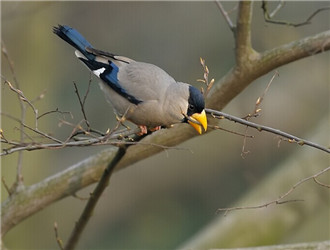
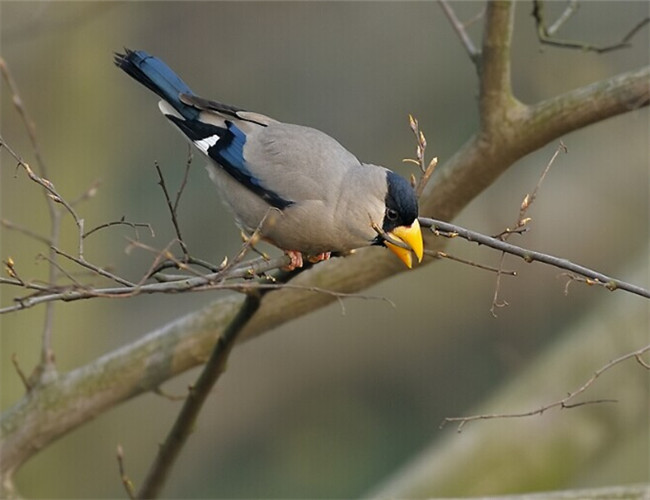
1 Hawfinch Breed Overview
The Hawfinch (Coccothraustes coccothraustes), also called the Waxbill, is one of China’s most popular pet birds and has great ornamental value. It is medium-sized, with an adult length of about 19 cm. Both males and females look adorably chubby and lovable.
Chinese name: Hawfinch
Other Chinese names: Waxbill
English name: Hawfinch
Kingdom: Animalia
Phylum: Chordata
Subphylum: Vertebrata
Class: Aves
Subclass: Neornithes
Order: Passeriformes
Family: Fringillidae
Genus: Coccothraustes
Species: Hawfinch
Subspecies: Yellow-tailed Hawfinch
Distribution: Heilongjiang, Jilin, Liaoning, Hebei, Beijing, northeastern and southeastern Inner Mongolia, Henan, Shandong, south to Shaanxi, Anhui, Zhejiang, Jiangsu, Hubei, Sichuan, Guizhou, Yunnan, Guangxi, Guangdong, Hong Kong, Fujian, and Taiwan.
2 Physical Characteristics of the Hawfinch
The Hawfinch is neither large nor small, usually about 19 cm as an adult. Its appearance is not as eye-catching as some birds, but it has long been one of China’s traditional caged birds and is much loved.
Males and females of this species look alike and have similar colors. The adult has black lores, base of the beak, and a tiny area of the chin; the crown and cheeks are brown, the feather color gradually deepening from crown to back of head, becoming deeper brown at the nape and forming some contrast with the cheek feathers; the neck has a broad gray band, wider at the back and narrower at the front, like a shawl; the shoulder and back feathers are tan, clearly darker than the gray rain-band of the neck.
The lower back is pale buff; the upper tail coverts are brown; the tail is notched, about the same brown as the upper tail coverts, but the outermost two tail feathers are brown with a shiny blue metallic luster, and the tip of each tail feather is white; the wing coverts are white or buff, forming a broad longitudinal white patch on the wing, in sharp contrast with the tan shoulder feathers; the flight feathers are black with a shiny blue metallic luster, like quenched iron, and some primaries are specialized, with square tips and a notch at the tip of the inner web.
The tips of the secondary flight feathers are all square, giving the wing a sawtooth-like shape at the closed end, like it has been cut — a feature no other bird has; below the body, from the gray neck region downward, the base color is pale brown and white; the chest, upper belly, and flanks are pale brown; the lower belly and under-tail coverts are pure white; the iris is brown; the beak is stout, gray with a metallic luster, with a tin-like texture, which is also the reason for the species’ name; the feet are pink. The female’s crown is slightly grayer than the male’s. The juvenile is a darker version of the adult, with fine brown streaks on the chest and flanks, flying in a wave pattern.
3 Hawfinch Habitat
Any animal hopes its home is clean and tidy; flying birds like the Hawfinch usually roost in mountains or plains in the wild, choosing different environments by season. For home keeping, providing a distinctive home is necessary.
The Hawfinch is mostly active alone or in pairs; outside the breeding season it likes flocks, sometimes gathering in groups of dozens or even over a hundred, frequently hopping among branches or flying between thickets, and sometimes going to the ground.
Both captive and wild Hawfinches have loud, pleasant calls. Captive birds can use a Hwamei or myna cage, but many enthusiasts like to keep them on a perch; with training they can learn skills other small birds cannot. Note to clean the cage and food/water dishes once a week, keeping food and water clean. For trained Hawfinches, feed only hemp seeds — after training each day, feed to fullness and give water; after feeding, place the bird somewhere quiet and do not feed it the rest of the time.
4 Hawfinch Care
The Hawfinch is a typical omnivorous bird that refuses nothing you offer it. It especially likes hemp seeds, sunflower seeds, and perilla and other oil-crop seeds, but frequent feeding of these is not recommended in captivity.
The Hawfinch’s food is mainly plant fruits and seeds, and also insects. The insects eaten include weevils, pear bugs, leaf beetles, ground beetles, sawflies, hawthorn butterflies, and other Lepidoptera, Coleoptera, Hymenoptera, and Diptera insects and larvae. Usually a small amount of greens and apple can be fed.
The Hawfinch’s cage has no special requirements, only that it does not hinder hopping. If used for training, tether it with a neck chain on a perch. The usual perch is wooden, about 40–50 cm long and 1.5 cm in diameter, with a section in the middle wrapped in cotton thread for perching. A newly bought bird is rather irritable, so pay attention to the chain length to avoid neck entanglement and death. If the bird cannot calm down and flips up and down, wet its feathers with water to control its activity, or feed it sunflower seeds.