Eurasian Hoopoe
2 Photo Gallery

1 Eurasian Hoopoe Breed Overview
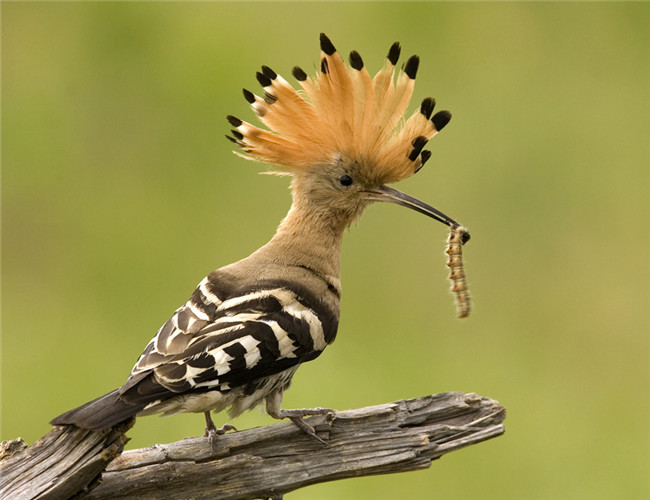
The Eurasian Hoopoe has a very distinctive appearance, with a crest like a crown on its head. It has 9 subspecies, a lively personality, and likes to perch on open, moist ground. When alert, it raises its crest, a very special look.
Chinese Name: Eurasian Hoopoe
Latin Name: Upupa epops
Aliases: Hupo, Huapushan, Mountain Monk, Crested Bird, Stinkbird
Kingdom: Animalia
Phylum: Chordata
Class: Aves
Order: Coraciiformes
Family: Upupidae
Genus: Upupa
Species: Eurasian Hoopoe
Subspecies: 9
Named by and Year: Linnaeus, 1758
English Name: Eurasian Hoopoe
English Name: Hoopoe
2 Eurasian Hoopoe Appearance
When alert, the Hoopoe raises its crest, a very special look, but relaxes it after takeoff. It has 9 subspecies; the crown-like crest on its head is its biggest feature.
Depending on subspecies, the Hoopoe is 26-28 cm long, wingspan 42-46 cm, weight 55-80 g. Head, neck, and breast are pale chestnut. The crest is slightly darker with black tips on each feather, and before the black tip on the rear feathers there is a white spot. The breast has a touch of pale wine color; the upper back and lesser wing coverts turn brown; the lower back and shoulder feathers are black-brown mixed with brown-white tips and edges; between the upper and lower back there are black, brown-white, and black-brown bands plus an incomplete white band, forming a broad band around to below the wing bend; the rump is white; the upper tail coverts are white at the base, black at the tip, partly with white edges; the tail feathers are black, each with a white spot in the middle extending to near the tip, forming an arc band. The wing outer is black, inward black-brown; the median and greater coverts have brown-white proximal bars; the primary flight feathers (except the first) have a row of white bars near the base; the secondary flight feathers have 4 rows of white bars; the tertials are mixed with brown-white diagonal streaks and edges. The belly and flanks go from pale grape-brown to white with brown streaks, to all white on the lower tail coverts. The iris is brown to red-brown; the bill black with a pale lead-purple base; the feet lead-black.
3 Eurasian Hoopoe Habitat
In the wild the Hoopoe likes to walk slowly on the ground. Because it is a migratory bird, it is rarely kept in captivity. It is gentle and not very afraid of people; its crest rises and falls with its movements, very beautiful.
The Hoopoe mainly inhabits mountains, plains, forests, forest edges, roadsides, river valleys, farmland, grasslands, villages, and orchards, especially forest-edge farmland. In winter it is mainly in low-altitude foothills; in summer it can reach 3,000 m. It is commonly seen alone or in pairs in open areas, farmland, or orchards of hills or plains foraging on the ground; when startled it flies to a nearby tree or a rock on a small hill not far away.
4 Eurasian Hoopoe Feeding Guidelines
The Hoopoe likes open, moist ground; in the wild it uses its long bill to dig and search for food on the ground. As it moves, its crown-like crest rises and falls.
The Hoopoe often walks slowly on the ground, foraging as it goes; when startled it flies to a branch or a short distance then lands again, flying with slow wingbeats in a wavy up-and-down motion. When perched or foraging on the ground, it spreads its crest like a fan, immediately closing it against its head when startled. It is fairly tame and not very afraid of people.