Eclectus Parrot
2 Photo Gallery

1 Eclectus Parrot Breed Overview
The Eclectus Parrot is distributed in many places in the world; it can be seen in Australia, Indonesia, New Guinea, etc. The Eclectus Parrot is a Least Concern species, and many people keep them. Compared with some large parrots, the Eclectus Parrot is relatively quiet, but it is not quiet all the time; occasionally you may hear their noisy calls.
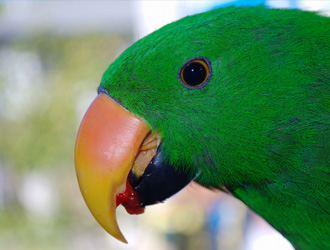
Another very big feature of the Eclectus Parrot is the great difference in appearance between males and females; some people seeing them for the first time may even think the male and female are two different breeds. The male is usually emerald green, while the female is deep red with a blue-purple belly.
Wild Eclectus Parrots generally appear in tropical rainforests and lowland forests; like many birds, they appear in pairs, but if they are in the breeding season, they appear in groups, and the groups are often male birds.
Chinese Name: Eclectus Parrot
Binomial: Eclectus roratus
Kingdom: Animalia
Phylum: Chordata
Subphylum: Vertebrata
Class: Aves
Subclass: Neornithes
Order: Psittaciformes
Family: Psittacidae
Subfamily: Psittacinae
Tribe: Rose Parrot Tribe
Genus: Eclectus
Species: Eclectus Parrot
2 Eclectus Parrot Physical Characteristics
The Eclectus Parrot’s body color differs greatly by sex; the green-bodied bird is the male, but of course it is not all green, with some specific parts having other colors, such as red in the armpits and a blue wide edge on the wing edges. The female’s body color is mainly deep red, but the area between her head and chest, and the belly, etc., are blue-purple, and the tail is orange, etc.
Because the Eclectus Parrot is a perching bird, its toes, like other perching birds, are two forward and two backward, which is very suitable for climbing, so we can see them stand steadily on branches.
The Eclectus Parrot has 10 subspecies; different subspecies have different sizes, for example the Australian Eclectus Parrot can reach 40 cm in length, while the Solomon Islands Eclectus Parrot is the shortest at only 30 cm. Of course, different subspecies also have different body colors, for example some females have a purple belly, some have a deep blue belly, and some have a red belly, etc.
Eclectus Parrot Physical Feature Description
Body length: about 37 cm.
Weight: about 430 g.
Color: Males mainly green, females mainly deep red. Generally, the male has a blue wide edge on the wing and wrist, and below, except the flight feathers are black, all the rest is red; in addition, its sides and armpits are also red, the tail tip is light yellow, and the outer tail feathers have some blue. The female has blue-purple between the head and chest and on the underside of the wings, and an orange tail.
Beak: Male red with yellow tip, female black.
Iris: Male orange, female pale yellow.
3 Eclectus Parrot Living Environment
The Eclectus Parrot is widely distributed on Earth and can live in many environments, such as tropical rainforests, grasslands, and even crop areas. Areas above 1900 m altitude are not their chosen habitat. In Australia, Indonesia, and other places, people most often see them in forests and near the sea. The Eclectus Parrot chooses these places as habitats not only because they adapt to the climate and environment, but also because these places provide the food they need. Because they also often look for food in crop areas, in some areas they are classified as pest birds.
Eclectus Parrots that have not been caught by humans usually forage in trees; if not in the breeding season, they often appear in pairs, sometimes just one bird. But if in the breeding season, the groups are generally male birds. Although the Eclectus Parrot is quiet compared with many parrots, when they gather they completely abandon their reserve and become noisy. At the same time, the Eclectus Parrot is also a very alert animal; at any slight movement they immediately activate their defense system.
The Eclectus Parrot is not small, so if caged, the owner must prepare a large cage for them. Note that an environment unsuitable for the growth of the Eclectus Parrot may lead to feather plucking (of course feed problems, disease, psychological reasons, etc. can also cause birds to pluck each other’s feathers). To avoid this, owners keeping this bird for the first time should first ask experienced pet friends or experts what environment is suitable for the Eclectus Parrot to live in.
4 Eclectus Parrot Feeding Guidelines
Strictly speaking, feeding the Eclectus Parrot is not difficult. Wild Eclectus Parrots mainly eat plant seeds, nuts, or fruits, so the owner does not need to worry too much about not being able to feed the Eclectus Parrot well. To let the Eclectus Parrot grow healthily, owners may wish to do the bird’s feeding well from the following points.
I. Water Supply
Tap water is actually not very suitable for Eclectus Parrots to drink, because the chlorine in the water is not good for their health; the owner should give the bird purified water.
II. Importance of Vitamin A and Fiber
Those who understand the Eclectus Parrot should know that the Eclectus Parrot needs a lot of vitamin A. And because the Eclectus Parrot’s digestive tract is longer than other parrots, the owner should give them more high-fiber and beneficial food.
III. Do Not Feed Only Seed Feed
Some owners may find they have worked hard to create a high-quality living environment for the bird, so why does it still lose feathers? This is very likely caused by long-term feeding of only seed feed. Long-term feeding of only seed feed not only causes the bird to lose feathers, but in severe cases can even cause the bird’s death. Fresh fruits and vegetables let the Eclectus Parrot grow better, but before feeding them fruits and vegetables they must be washed clean, and fruits are best cut into small pieces convenient for them to eat. The Eclectus Parrot may also have its own favorite fruits and vegetables, and the owner can appropriately increase the supply.
IV. Provision of High-Quality Protein
Getting high-quality protein is not difficult; directly crush a boiled egg (shell not peeled) to provide high-quality protein. In addition to eggs, the Eclectus Parrot can also eat a little fish. But the Eclectus Parrot cannot eat food containing salt, sugar, and other seasonings, so be careful when cooking fish.
V. Foods Absolutely Not to Be Fed to the Eclectus Parrot
Chocolate, avocado, pork, food containing alcohol or various seasonings, etc. cannot be fed to them. If the owner is unsure whether a food can be fed to the bird, consult a veterinarian or expert first to avoid accidents.
5 Eclectus Parrot Care Tips
The Eclectus Parrots appearing in the pet trade mainly have two sources: one is direct wild trapping, the other is captive-bred birds. Generally, wild Eclectus Parrots are not suitable as pets; compared with artificially bred birds, they are more likely to get sick and have a very high mortality rate. Although some vendors sell them cheaply, owners find them hard to keep alive, so wild Eclectus Parrots are not recommended for purchase.
Captive-bred Eclectus Parrots, in addition to high survival rate, also adapt to the new environment faster. Note that the Eclectus Parrot also has considerable personality differences by sex; male birds are lively and affectionate, can get familiar with the owner in a short time, but female birds are the opposite—they are introverted; when first kept, they may hide, but this improves a lot after adapting to the new environment.
We all know many parrots are noisy, so owners usually need to consult family and neighbors before keeping. The Eclectus Parrot is not the kind that bothers you with noise all day; compared with many parrots, they are quieter, of course they also have noisy times, and those who want to keep them need to be mentally prepared.
The Eclectus Parrot can also be bred under artificial conditions, but some problems may appear in breeding, such as unfertilized eggs. When a breeding problem occurs, the owner needs to find the cause first, then ‘prescribe the right remedy.’ Although the Eclectus Parrot may have breeding ability before age 5, to increase the chance of successful breeding and ensure offspring quality, the owner should let them breed after age 5.