Cockatiel
2 Photo Gallery
1 Cockatiel Breed Overview
The Cockatiel (Cockatiel) goes by different names in different regions; in Hong Kong and Taiwan it is often called the Crested Parrot. The Cockatiel is one of the most common medium-sized parrots in the world. Hand-reared young birds are very lively and love to bond with their owners.
The Cockatiel has many color mutations, the more common being gray, white, and pearl. It is said the name ‘Cockatiel’ originated when Dutch sailors in Australia called them ‘cacatitho’ in Portuguese, meaning ‘small cockatoo’. Their total global population exceeds one million and is still growing; the population is stable and secure.
Chinese Name: Cockatiel
Also Known As: Crested Parrot, Quarrion
English Name: Cockatiel
Binomial: Nymphicus hollandicus, Kerr, 1792
Kingdom: Animalia
Phylum: Chordata
Subphylum: Vertebrata
Class: Aves
Subclass: Neornithes
Order: Psittaciformes
Family: Psittacidae
Subfamily: Cacatuinae
Tribe: Cockatiel
Genus: Nymphicus
Subgenus: None
Species: Cockatiel (N. hollandicus)
Subspecies: None
2 Physical Characteristics of the Cockatiel
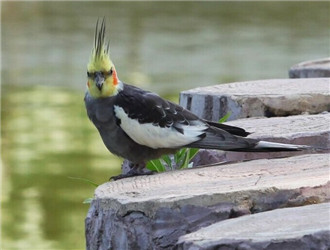
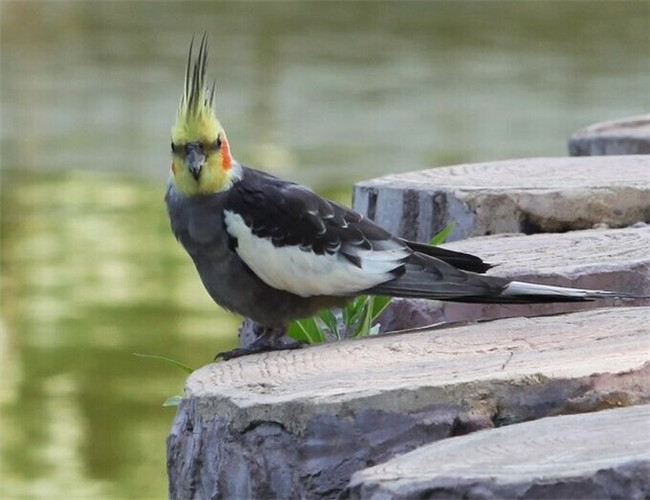
An adult Cockatiel reaches about 33 cm in length. Its most distinctive feature is a prominent, long crest, especially in the wild where the crest can reach about 5 cm. The Cockatiel has no subspecies; it is divided into 18 different color mutations by color, with a few uncertain exceptions. Its feet are suited to climbing, with two toes pointing forward and two backward.
A tame Cockatiel’s crest is 4-11 cm long. Weight 80-100 g, lifespan 20 years, with the oldest known reaching 36 years. It is a small parrot of the cockatoo family. Like other cockatoos (such as the Sulphur-crested Cockatoo), the Cockatiel has an erect crest on its head. In addition, the Cockatiel and the Sulphur-crested Cockatoo share other features: the facial feathers cover both sides of the beak, a trait rare among parrots outside the cockatoo family. Unlike most cockatoos, the Cockatiel has long tail feathers, about half the body length. The Cockatiel’s distinctive crest stands upright when startled or excited, and tilts when the bird is relaxed.
The Cockatiel’s plumage is generally medium gray, lighter on the lower body, with orange cheeks and a large white patch on the wings. Female Cockatiels have a row of small yellow spots under the wings, which males lack. There are other mutations, such as the lutino Cockatiel with pale yellow plumage. Female lutinos also have spotted tail feathers. Both sexes have yellow facial feathers: the female’s beak and eye area are covered with yellow down, while the male’s head and front of the crest are mostly yellow.
3 Cockatiel Habitat
The Cockatiel is a typical perching bird and can be kept on a standard parrot stand; it loves to chew constantly, so the cage should be metal or bite-resistant.
It mainly inhabits various dry and semi-dry woodlands, shrubland, riverside forest, thorn scrub, orchards, farmland, plains, and roadside areas.
Each breeding cage for a pair of Cockatiels is 60 cm long, 45 cm wide, and 40 cm high; perches should be hard wood or hard branches about 2 cm in diameter. Feed and water containers should be sturdy and stable to avoid being bitten or knocked over. The nest box can be a closed plywood box 30 cm long, 20 cm wide, and 16 cm high, with a 5 cm partition in the middle and a 6-7 cm entrance on the front, lined with sawdust. A sand tray is best made of a metal pan. The water bottle should be cleaned daily or every other day, with clean drinking water replaced. Greens should be fed daily or every other day. The sand tray should be cleaned 1-2 times a week, and food and water containers disinfected monthly. In spring and autumn, when temperatures fluctuate, adjust room temperature to prevent disease. In winter keep warm, with indoor temperature not below 16 C. In summer, when temperatures are high (generally above 30 C), increase ventilation.
4 Cockatiel Feeding Guidelines
The Cockatiel is undemanding about food and not picky at all, so it is robust and disease-resistant. It is easy to keep and breed, ideal for beginners, and rarely dies under normal care. But do not let feed or water run out, and do not make the diet too monotonous.
Wild Cockatiels like to forage on the ground, usually eating seeds, grass, leaves, and bark (from various trees, shrubs, and other vegetation). They also eat grubs and various insects. They feed twice daily, shortly after sunrise consuming about 2.72 g of plant food, and about 1.5 hours before dark about 4.25 g, eating nearly 700 g per day.
Feed mainly consists of millet, panicum, barnyard grass, rice, hemp seed, sunflower seed, egg-millet, and greens such as rape. Grain mix ratio: 40% millet, 20% panicum, 10% rice, 20% hemp seed, 10% sunflower seed, mixed evenly. For egg-millet, add 2 g salt and 4-6 g of multivitamins, calcium powder, and trace elements per 1 kg of millet.