Cape Parrot
2 Photo Gallery
1 Cape Parrot Breed Overview
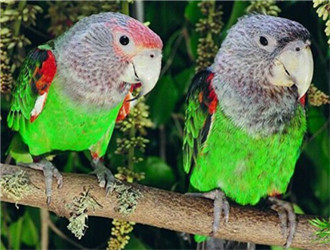
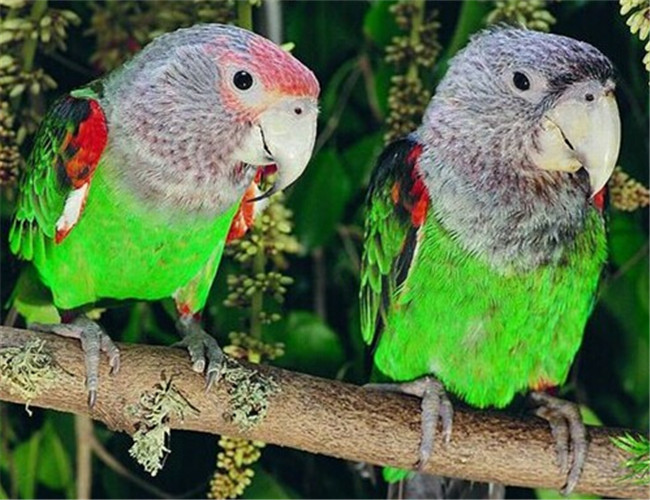
The Cape Parrot (Poicephalus robustus) has plumage very similar to most other parrots, and is hard to tell apart without professional expertise. However, the Cape Parrot’s sex can be judged by appearance: the female has orange-red crown feathers on her head, while the male does not.
Chinese Name: Cape Parrot
Chinese Alias: Cape of Good Hope Parrot
English Name: Cape Parrot
Binomial Name: Poicephalus robustus
Kingdom: Animalia
Phylum: Chordata
Class: Aves
Order: Psittaciformes
Family: Psittacidae
Tribe: African Parrots
Subspecies: Three
Distribution: Southeastern Africa
2 Physical Characteristics of the Cape Parrot
With good care, the Cape Parrot lives on average about 25–50 years and is very suitable as a pet bird. An adult Cape Parrot is about 34 cm long, and its ideal adult weight should be between 260 and 330 g.
Most of the body is green; the head is brown-green and yellow-brown with dark brown spots and deep green; some birds have dark pink cheeks, and occasionally a few red feathers on the crown; the chest, abdomen and tail have some blue; the back and wing coverts are black with a very wide green edge, and the wing edges and thighs are orange-red; the tail feathers are brown-black, the beak is grayish-white, and the iris is dark brown. The female has a patch of orange feathers on the forehead. Juveniles lack the orange-red on the thighs and wing edges, usually have scattered red feathers on the crown, and have olive-brown heads and necks; after 9–12 months, the head may develop a silvery-gray color.
3 Cape Parrot Care Tips
Cape Parrots usually breed from March to June and from October to December each year. During the breeding season they like to fly in pairs or flocks, accompanied by noisy calls in flight, making them quite conspicuous.
Captive Cape Parrots mostly begin breeding in late spring or summer, gaining breeding ability at age 3 and achieving breeding success at age 4. They should not be disturbed often during the breeding period. A clutch is about 2–4 eggs, with an incubation period of about 24–30 days; if the parents raise the chicks to weaning, two broods a year are possible, though the success rate is not high. The chicks’ feathers develop over 9–14 weeks. A thick wooden nest box of 30×30×60 cm can be provided. They lay 2 to 3 eggs at a time, with an incubation period of 26 to 28 days, and the chicks’ feathers develop over about 9 to 11 weeks. After leaving the nest, the chicks are fed almost entirely by the male, and become independent 2 to 3 weeks after leaving the nest.
4 Cape Parrot Feeding Guidelines
The Cape Parrot is a relatively rare parrot on the market, and imported captive-bred Cape Parrots are quite expensive. A newly purchased Cape Parrot is timid and shy around strangers, but becomes very quiet once past the adjustment period, though some individuals are noisy in the morning.
Cape Parrots have a fairly strong bite. Their food mainly consists of seeds, nuts (they love walnuts and pecans), berries, fruit and nectar; sometimes they visit farmland to forage on crops such as corn and apples, and they have been observed eating dry peanuts. Supplement vitamins and minerals regularly. Keep them in a sturdy metal cage.