Black Drongo
2 Photo Gallery
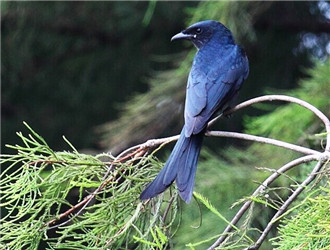
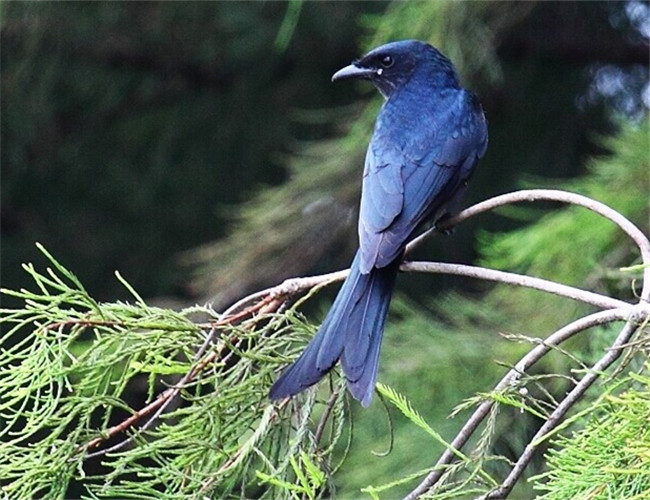
1 Black Drongo Breed Overview
The Black Drongo (Dicrurus macrocercus) is fierce by nature, especially during the breeding season when it is highly territorial, and is usually very active and likes to fight in groups. In the wild it feeds mainly on insects. It is now mainly distributed from Iran and Afghanistan through South and Southeast Asia to Java and Bali.
English name: Black Drongo
Binomial name: Dicrurus macrocercus
Kingdom: Animalia
Phylum: Chordata (Phylum Chordata)
Subphylum: Vertebrata
Class: Aves
Subclass: Neornithes
Order: Neognathae, Passeriformes
Suborder: Passeri
Family: Dicruridae
Genus: Dicrurus
Species: Black Drongo
Distribution: Iran and Afghanistan southeast through South and Southeast Asia, Russia, Taiwan, and mainland China including Heilongjiang, Jilin, Liaoning, Inner Mongolia, North China provinces, west to Shaanxi, Sichuan, Tibet, the Yangtze basin, west to Yunnan, and Hainan.
2 Physical Characteristics of the Black Drongo
The adult Black Drongo is about 30 cm long, all black, with a metallic blue sheen on the upper body, chest, and tail. It is named for its outermost pair of tail feathers that curl upward and outward, together with its entirely black plumage.
Adult male (breeding plumage): the whole body is glossy black; the forehead and lores are velvety black (some specimens show a faint whitish spot at the mouth corner). The upper body from head and back to rump and upper tail coverts is deep black with a copper-green metallic sheen; the tail is deep black with a copper-green sheen on the surface; the central pair of tail feathers is shortest, increasing outward, the outermost pair longest, with the tip curling upward and outward, the tail tip deeply forked; the wings are blackish-brown with a copper-green metallic sheen on the outer webs and coverts. The underbody from chin and throat to under-tail coverts is blackish-brown, with the chest showing the strongest copper-green sheen; the under-wing coverts and axillaries are blackish-brown.
Adult female: similar to the male, but with slightly weaker copper-green sheen.
Juvenile: body feathers blackish-brown, the back and shoulders with slight metallic sheen; from the lower back to the upper tail coverts blackish-brown with whitish-gray tips forming scale-like edges; tail blackish-brown; wing angle whitish-gray. The belly, flanks, and under-tail coverts are blackish-brown with whitish-gray edges; some specimens have under-tail coverts blackish-brown at the base with whitish-gray tips up to 11 mm, appearing whitish-gray.
Nestling: covered in dark brown-black down in the nest.
Iris reddish-brown; bill and feet dark black; claws dark horn-black.
3 Black Drongo Living Environment
Because the Black Drongo’s tail is long, use a larger cage, such as a bird stand or myna cage. In the wild it likes to inhabit villages in suburbs and rural areas, especially breeding in tall toon trees in front of and behind farmhouses. It pairs up and lives in broadleaf trees below 800 m in hills and plains; in Tibet it lives in mixed coniferous-broadleaf forest edges at 2000-2500 m. A home environment can follow the guidance below.
The Black Drongo’s droppings are loose and corrosive, so wash the perches twice a week and clean the cage once a week to avoid foot contamination. In northern winters it must be kept indoors; in the south, cover the cage with gauze at night in summer to prevent mosquito bites.
The Black Drongo flies gracefully, and a large flight cage can train it to catch food in flight, which is pleasing to watch. When tethered, start with a long leash and use insects to lure it to catch food, then release it indoors to chase thrown food-it is truly charming. Trained birds can be let outside to play, but control the bird’s hunger or use a neck ring, and proceed gradually to avoid escape.
4 Black Drongo Feeding Guidelines
The Black Drongo’s feed can be arranged by your situation. Owners with time can make food themselves, provided nutrition is balanced; busy owners can buy ready-made feed or offer human fruits and vegetables. Below we detail the Black Drongo’s feeding.
For chicks, mix meat paste, hard-boiled egg yolk, and cornmeal (or chicken feed) in a 6:2:2 ratio with vitamins and trace-element additives, and thin with water into a porridge (for tiny chicks with feather buds) or a dough (for feathered young). Feed chicks with a bamboo spatula; young birds can be fed hand-rolled 1 cm pointed food balls. Adults are fed only soft food, similar to the chick mix but with added fruit and vegetable bits.
You can feed the Black Drongo entirely on soft food, twice a day morning and afternoon. To keep feed fresh and the bird full, feed on a schedule so it forms regular habits; because soft food spoils easily, especially in summer or the plum-rain season, the afternoon portion can be fed later and removed right after eating-never leave it overnight. Newly caught adults are quite wild; keep them in a dim, quiet cage, feed in the afternoon or dusk with feed the size of a soybean in the dish for self-feeding. If they do not eat for a long time, pry the beak open to feed; after 2-3 days, as they settle, switch to dish feeding. New birds start calling on their own after 3-5 days.