Black-cheeked Lovebird
2 Photo Gallery

1 Black-cheeked Lovebird Breed Overview
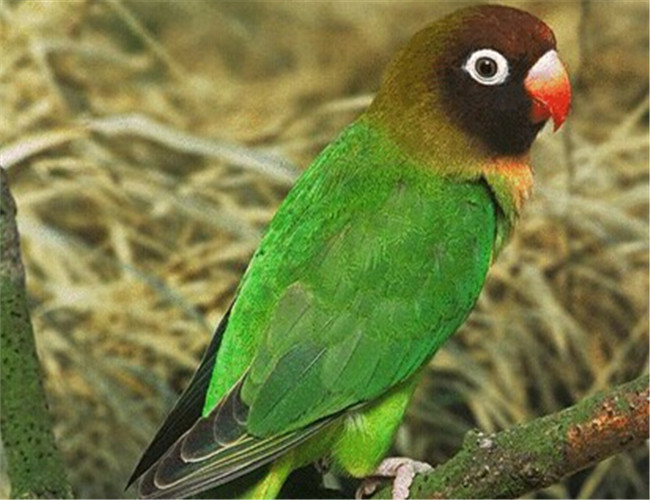
The Black-cheeked Lovebird (Black-cheeked Lovebird), also called the Black-cheeked Lovebird or Black-masked Lovebird, derives from the Greek ‘Agape’ meaning love and ‘Ornis’ meaning bird, hence ‘lovebird’. Its plumage is very brilliant, and heavy capture for the pet trade has reduced wild numbers.
Chinese Name: Black-cheeked Lovebird
Also Known As: Black-cheeked Lovebird, Black-masked Lovebird
English Name: Black-cheeked Lovebird
Binomial: Agapornis nigrigenis
Kingdom: Animalia
Phylum: Chordata
Class: Aves
Order: Psittaciformes
Family: Psittacidae
Tribe: African Parrots
Genus: Agapornis
Distribution: South-central Africa
2 Physical Characteristics of the Black-cheeked Lovebird
The ideal adult body length is 13 cm and ideal weight about 40 g. The body is green. Adult Black-cheeked Lovebirds are hard to tame, so it is best to keep a young bird.
The parrot’s forehead and front crown are red-brown; the area between the eye and bill, the cheeks, and throat are black-brown; the back of the head and nape are dark yellow-green; the upper breast is orange-red, fading to yellow-green toward the lower breast; the belly and inner tail coverts are yellow-green, the tail pale green; there is a broad white eye-ring, the bill is red, and the iris brown. The juvenile is duller with a black-tipped bill.
The Black-cheeked Lovebird’s nape is orange and breast green. In the wild it is very rare, about 10,000 left, and because most captive lovebirds are cross-bred, pure captive Black-cheeked Lovebirds are quite rare; hybrids have many color mutations and are among the most common small parrots, some rare mutations priced high. Hand-reared birds are active and lovable but can be naughty, disobedient, or unstable; they move quickly and agilely, so beware they do not escape. If you want a young bird to bond with you and not fear strangers, keep only one, because a pair will bond closely with each other and not with you, even if hand-reared, though not every bird is like this.
3 Black-cheeked Lovebird Habits
Like other parrots, the Black-cheeked Lovebird loves bathing and chewing. Caged birds are not very loud but love to call and can be annoying. Newly imported birds are very sensitive to the environment but become robust after adapting. It mainly inhabits acacia shrubland, thorny plains, and open grassland between 600 and 1000 m, preferring river valleys.
4 Black-cheeked Lovebird Care
In the wild the Black-cheeked Lovebird usually breeds in November and December; in captivity it breeds in spring with a low rate. Raised from a young age it is very tame and not very noisy.
During breeding provide a thick wooden nest box 20x20x30 cm; the Black-cheeked Lovebird lays 3-6 eggs, incubation 20 days, chicks’ feathers grown in about 32 days. If minerals are lacking, the parents may pluck the chicks’ feathers; with good care they can breed several times a year, but for the parents’ health do not exceed twice a year.
Low difficulty: provide nesting materials (straw, branches, paper) for them to build; can be colony-bred, breeding year-round, 4-6 eggs per clutch, often with infertile eggs, incubation about 18-23 days, sometimes the female starts incubating only after the second egg; chicks’ feathers grow in about a month. During chick-rearing provide ample food; if parents lack minerals they may pluck chicks’ feathers, so consider hand-rearing the chicks at about two weeks or earlier.