Black-capped Lory
2 Photo Gallery
1 Black-capped Lory Breed Overview
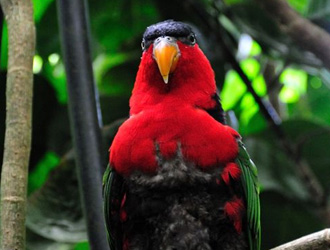
The Black-capped Lory is a very beautiful bird whose plumage is varied and vivid, which is why it is loved by many. Its most obvious and well-known feature is its black crown, as if wearing a black cap. Unlike some other parrots that eat plant seeds, the Black-capped Lory feeds mainly on nectar, pollen, and fruit.
Indonesia and Papua New Guinea are the main wild distribution areas of the Black-capped Lory. Thanks to its beauty and decent talking ability, it has also become a pet kept by many. To keep one well, the owner must be attentive and very patient, because caring for a Black-capped Lory may not be as simple as you think.
Like many animals, the Black-capped Lory has aliases, such as Black-headed Lory, Black-capped Parrot, and Black-capped Lory. Its English name is Black-capped Lory.
Chinese Name: Black-capped Lory
Binomial: Lorius lory
Kingdom: Animalia
Phylum: Chordata
Subphylum: Vertebrata
Class: Aves
Subclass: Neornithes
Order: Psittaciformes
Family: Psittacidae
Subfamily: Loriinae
Tribe: Lorini
Genus: Lorius
Species: Black-capped Lory
Subspecies: 7 subspecies
2 Black-capped Lory Physical Characteristics
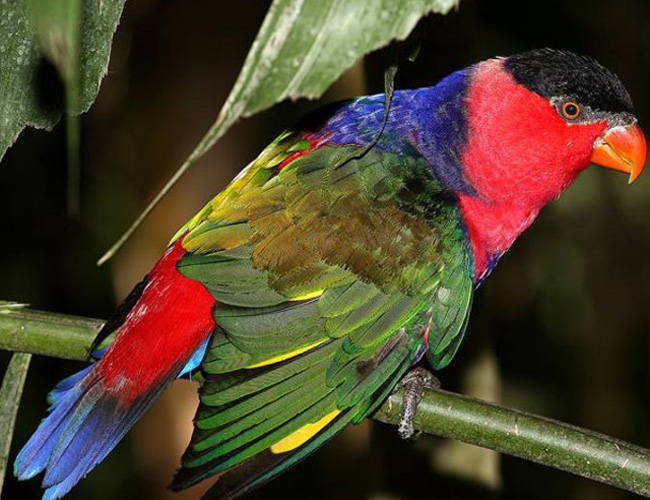
Compared with some parrots whose body color is mainly green, the Black-capped Lory is far more brilliant. Its body color is not only varied but also vivid, red, yellow, blue, and green all appearing. Most importantly, so many colors on the Black-capped Lory do not look strange at all; instead they become a beloved characteristic.
The Black-capped Lory is usually about 32 cm long and generally weighs about 230 g, so in captivity the owner must provide a suitably sized cage and nest box based on the parrot’s actual condition.
The Black-capped Lory has 7 subspecies: the Biak subspecies, the Salvadori subspecies, the Helauc Bay subspecies, the nominate subspecies, the Astrolabe Bay subspecies, the Prari River subspecies, and the Humboldt Bay subspecies.
Description of physical features:
Body length: about 32 cm.
Weight: 230 g.
Head: red, with a black crown.
Beak: pink.
Iris: black.
Wings: green.
Underwing coverts: yellow.
Legs: blue.
Mantle and belly: broad striping.
Note: Subspecies differ in color.
3 Black-capped Lory Living Environment
In captivity, creating a good living environment for the Black-capped Lory is one factor in ensuring healthy growth. In fact, many people may not know much about this breed before seeing one, but if you want to keep it, you must clearly understand what kind of environment suits it best.
Wild Black-capped Lories are widely distributed; their habitats include forests, swamp woodlands, and low hilly areas, and they are hard to find at higher altitudes (over 1,550 m). Some birds form very large flocks in nature, but the Black-capped Lory is not like that; it usually moves in small flocks of about 10 birds.
Of course, the captive environment differs from the natural one, but as long as conditions are suitable, the Black-capped Lory adapts to a new environment fairly quickly. Take cage preparation: regardless of the bird, the owner must prepare according to the bird’s traits. The Black-capped Lory usually exceeds 30 cm in length, so cage size is very important. Besides size, cleanliness and temperature control are things the owner must attend to.
If you encounter problems keeping a Black-capped Lory, do not act on what you ‘think’ is right. When you do not know how to handle a problem properly, seek help from a professional promptly to avoid accidents.
4 Black-capped Lory Care Tips
If you love the Black-capped Lory and want to keep one as a pet, you had better not buy a wild-caught bird, because wild birds have low survival rates and breed very poorly. Captive-bred Black-capped Lories are relatively easier to keep; they are lively and can easily win over bird lovers.
I. Diet of the Black-capped Lory
In the wild, the Black-capped Lory feeds mainly on pollen, nectar, and fruit, while the one in a human home can eat specially formulated food. Unlike some parrots, the food prepared for the Black-capped Lory is mostly in powder form. Of course, the owner should also provide an appropriate amount of fruit, etc.
II. Environment of the Black-capped Lory (see article: How is the Black-capped Lory’s living environment?)
1. The Black-capped Lory has certain temperature requirements. When first kept, the owner must keep the ambient temperature above 25 C; in winter, keep it above 15 C.
2. A characteristic of the Black-capped Lory, its droppings are watery, means the owner must change the nesting material frequently; if not changed promptly, it harms the bird’s healthy growth.
III. Breeding the Black-capped Lory
During the breeding season the Black-capped Lory seems to become very irritable; it can be aggressive not only toward other species but also toward its mate, and fights may occur. The owner must take measures to prevent injury or even death. Many birds are sensitive to the owner checking the nest box during breeding, but the Black-capped Lory is not very sensitive to this, which also makes it easier for the owner to change nesting material.