Bearded Parrotbill
2 Photo Gallery
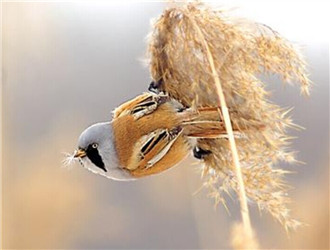
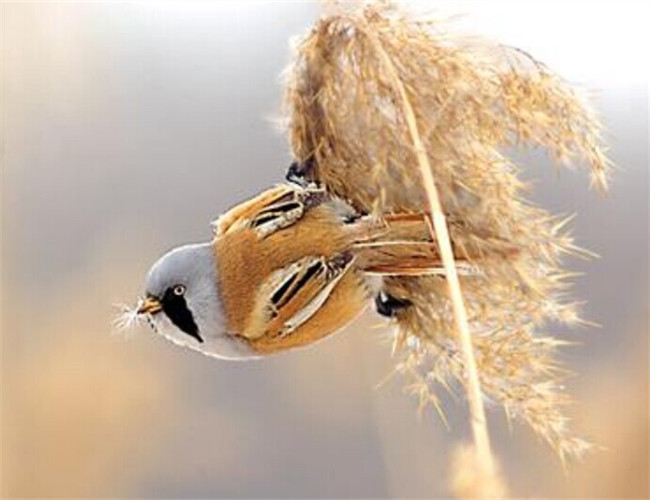
1 Bearded Parrotbill Breed Overview
The Bearded Parrotbill (Bearded Parrotbill), also called the Bearded Tit, is small and exquisite, moves agilely, and flies quite fast. Its difference from other birds is in nesting: ordinary birds usually nest on branches, while the Bearded Parrotbill usually nests at the lower part of reeds or shrubs, also on fallen reed piles or old reed stubs.
Chinese Name: Bearded Parrotbill
Chinese Alias: Bearded Tit
English Name: Bearded Parrotbill
Order: Passeriformes
Family: Sylviidae
Genus: Panurus
Distribution: Regionally common in suitable reed habitats in northern China.
2 Bearded Parrotbill Physical Characteristics
The ideal body length of the Bearded Parrotbill should be about 16 cm; males and females look very similar, the difference being that the female’s head is not gray but gray-brown, the lores are not black but gray-brown, and there is no black mustache-like spot below the eye and cheek. All else is similar. Iris orange-yellow, bill also orange-yellow or yellow-brown, feet black.
The forehead, crown, and sides of the head are pale smoky gray or gray; the forehead, sides of the head, and ear coverts are usually paler, whitish gray or pale gray; the lores and around the eyes are black and extend down through the cheek along the zygomatic area forming a cluster of black mustache-like spots. The back, shoulders, and lower back (upperparts) are pale brown or ochre yellow, the shoulders more brown, the upper tail coverts pinkish ochre yellow or pale pink-purple. The tail is long and emarginated; the central pair of tail feathers is longest, ochre yellow or brown-yellow; the outer tail feathers shorten in sequence, red-brown or red ochre yellow, with gray or off-white terminal spots; the outermost pair of tail feathers has white tip and outer web, black base and inner web. The wing coverts and tertials are black with tea-yellow edges; the innermost tertial is white; the primaries are black-brown, the outer web of outer primaries with silver-gray or bright off-white edges, the inner web with pale brown or pale yellow-white edges; the rest of the secondaries have pale brown-yellow outer web edges and tips, the secondaries also black-brown with brown outer web edges and milky white or pale yellow-white inner web edges and tips. The chin, throat, and upper breast are pale yellow-white or gray-white; the sides of the neck and breast are tinged pink or gray-purple; the flanks are pale brown-yellow; the center of the belly is milky white or milky yellow tinged with purple; the undertail coverts are black.
3 Bearded Parrotbill Care & Keeping
The Bearded Parrotbill has a relatively lively personality, moves agilely, and likes to perch among reeds, especially reeds near the water surface; you often hear calls but cannot see the bird. The Bearded Parrotbill reproduces by oviparity, usually breeding from April to July each year, and during breeding often stands on top of reeds calling.
During breeding, the Bearded Parrotbill usually nests at the lower part of reeds or shrubs, also on fallen reed piles or old reed stubs. The nest is a deep cup, mainly made of dry reed stems, shrub leaves, or reed leaves, sometimes padded with a little weeds and feathers, built in pairs or groups as a colony. The nest diameter is 7–9 cm, height 15–25 cm; the nest-building work is shared by both sexes. Each clutch usually has 5–6 eggs, sometimes as few as 4 and as many as 7 or 8, and there are reports of up to 12. The eggs are white with dark spots; average egg size is 17.35 mm × 13.97 mm. Both sexes take turns incubating; incubation period 12–13 days, also reported as 15–16 days. The chicks are altricial; both parents feed them; nestling period 11 ± 1 days; 2–3 broods per year.
4 Bearded Parrotbill Feeding Guidelines
Because the Bearded Parrotbill is a close relative of the Hwamei (melodious thrush) and the Red-billed Leiothrix, you can refer to their daily keeping methods. The staple can be mainly Hwamei pellets; usually you can feed them fruits such as apples, cucumber, watermelon, etc., but be reminded not to feed too much fruit, as it easily causes diarrhea in the Bearded Parrotbill. See below for specifics.
The Bearded Parrotbill’s food is mainly insects, spiders, and reed seeds and grass seeds. During breeding, insects dominate; most other times it eats mostly reed seeds and grass seeds. Mealworms (2–3 per day).
In keeping, you can also feed egg-and-millet and Hwamei pellet feed; it can be kept singly, but small birds do not live long; the Bearded Parrotbill has no captive-bred individuals, and being able to keep it alive for two years is already good.