Crimson Rosella
2 Photo Gallery
1 Crimson Rosella Breed Overview
Crimson Rosella (details)
The Crimson Rosella (Crimson Rosella) has very bright, beautiful adult plumage and usually travels in pairs or flocks, mainly distributed in Australia and on Norfolk Island. The breeding season is roughly September to January each year.
The juvenile Crimson Rosella’s plumage differs greatly from the adult’s—juveniles are olive-green and gray-green, gradually changing over time to red, green, and blue mixed, and only fully becoming the adult color at about 15 months. The male has a larger, flatter head and bigger beak; to tell a juvenile’s sex, the head and beak are the clearest parts. There are 3 subspecies.
Chinese Name: Crimson Rosella
Chinese Alias: Red Grass Parrot
English Name: Crimson Rosella
Kingdom: Animalia
Phylum: Chordata
Class: Aves
Order: Psittaciformes
Family: Psittacidae
Tribe: Australasian Parrots
Genus: Platycercus
Species: Crimson Rosella
Distribution: Along Australia’s east coast, mainly the coastal regions of southeastern New South Wales and Victoria, small coastal areas of southeastern South Australia and Kangaroo Island; in the northeast distributed along coastal Queensland and its southeast; also on some small islands off southeastern Australia.
2 Physical Characteristics of the Crimson Rosella
Crimson Rosella (details)
The ideal Crimson Rosella should be about 34 cm long, weighing 115–170 g. Its deep-red feathers are the most eye-catching feature, and it has long been a popular pet bird with many keepers.
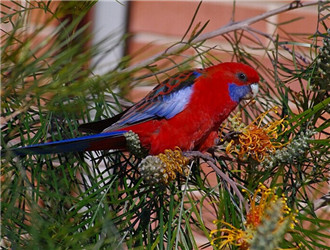
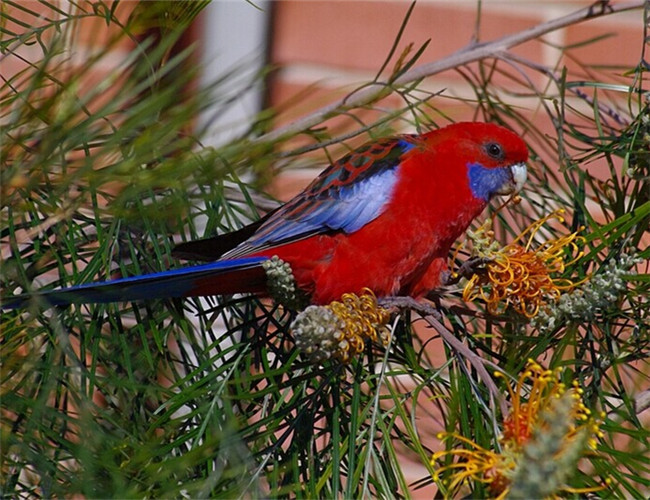
The Crimson Rosella’s cheeks are blue-purple; the neck, back, and part of the secondaries are black with a wide red edge; the inner median wing coverts are black, the bend of the wing, outer median coverts, and secondary coverts are blue; the outer secondaries, base of the primaries, and underwing coverts are blue; the central upper tail is black-based deep blue, the outer tail deep blue with very light edges and tips; the inner tail is light blue; the beak gray-white, iris dark brown. The female is slightly smaller, with greenish feathers on the central upper tail and a finer, shorter, narrower beak. The juvenile is olive-green and olive-yellow with only a little red; forehead and crown red, cheeks blue, the rest—except throat, upper chest feathers, thighs, and underwing coverts—olive-green. The inner tail is light blue with light streaks on the wings, taking 16 months to reach adult coloration.
3 Crimson Rosella Living Environment
Crimson Rosella (details)
The Crimson Rosella tolerates heat better than people, but what it fears most is an overly damp environment—the plum-rain season is simply terrible for it.
If the air is stuffy and oxygen drops, the Crimson Rosella feels extremely unwell. Then the owner should turn on air conditioning to cool and dehumidify the indoor air, and not place the bird on an unventilated balcony. In winter, keep it in a room without a humidifier to avoid dampness and illness. Heating poses no threat; to it, damp is worse than heat.
In the wild the Crimson Rosella mainly inhabits humid to semi-humid forests around 1,500 m, sometimes up to 1,900 m; it is often found in forests with over 500 mm annual rainfall. Northern Australian populations like hilly woodland at 600–1,500 m, but can be found from 450–1,900 m; southern populations range across various elevations. Juveniles also gather in tropical grassland, farmland, and small woodland patches; sometimes they appear in rainforest, orchards, parks, and gardens.
4 Crimson Rosella Care and Breeding
In this vast world, countless people keep pet birds, each with a favorite species—popular ones being mynas, parrots, and of course the Crimson Rosella. As the Crimson Rosella grows more popular, more people keep it. Do these owners know how it reproduces?
5 Crimson Rosella Feeding Guidelines
Crimson Rosella (details)
The Crimson Rosella is actually an omnivorous bird; after long survival in the wild it is not picky about food. For home keeping, for balanced nutrition you can feed pellets, with snacks at will but in small amounts.
The Crimson Rosella mainly eats grass and shrub seeds, vegetation, plant shoots, berries, fruit, millet, a little sunflower seed, and green vegetable flowers, insects and their larvae. Because it often visits farmland to feed, farmers consider it a pest.
This sturdy bird kept in a 3.6 m aviary shows beautifully colorful feathers in the sun.