Cuban Parrot
2 Photo Gallery
1 Cuban Parrot Breed Overview
The Cuban Parrot is a typical perching bird, listed under CITES Appendix I, a critically endangered first-class protected parrot. It has 4 subspecies, mainly distributed in mountain forests and low-latitude woodland.
Chinese Name: Cuban Parrot
Latin Name: Amazona leucocephala
Also Known As: Cuban Amazon, Cuban White-fronted Amazon
Kingdom: Animalia
Phylum: Chordata
Class: Aves
Order: Psittaciformes
Family: Psittacidae
Genus: Amazona
Species: Cuban Parrot (Amazona leucocephala)
Subspecies: 4
Named by and Year: Linnaeus, 1758
English Name: Cuban Amazon
English Name: Bahamas Parrot
English Name: Caribbean Amazon
English Name: Cuban Parrot
2 Physical Characteristics of the Cuban Parrot
The Cuban Parrot is a typical perching bird with zygodactyl feet (two forward, two back) suited to grasping. Its brilliant plumage and handsome looks make it very appealing.
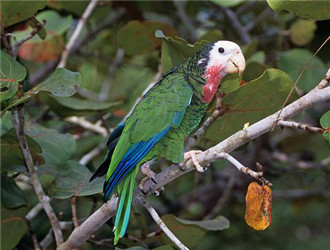
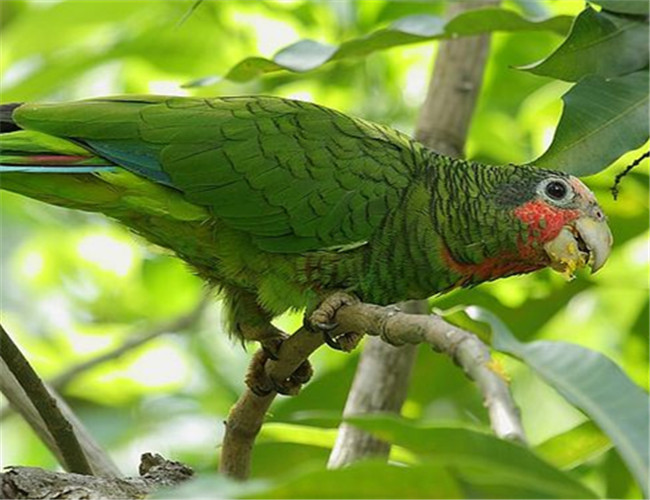
Depending on subspecies, body length is 30-34 cm and weight 240-262 g. The body is green with a black edge on each feather; the forehead, crown, and area around the eyes are white; the cheeks, throat, and breast are pink; the coverts near the ears are deep black; the lower belly has dark red feathers; the primary flight feathers and wing edges are blue; the inner tail feathers are yellow-green; the bill is wax-white and the iris red-brown.
There are 4 subspecies, differing mainly in head and belly color. The nominate adult is deep green with broader belly markings and deeper red throat. The Cayman Islands subspecies adult is more yellow or green, with more obvious scalloped feathers, blue on breast and rump, white head limited to the forehead, green on the neck sides separating the red throat from the cheeks, larger size. The Cayman Brac subspecies is overall yellow-green, adult with more obvious chestnut belly markings, darker cheeks and throat, smaller size. The Bahamas subspecies has small or no belly markings, white crown extending further back to the lores and upper cheeks, less red at the tail base, larger size.
3 Cuban Parrot Habitat
The Cuban Parrot is naturally shyer than some large Amazons, more prone to stress and feather-picking, and less bonded to humans. So in captivity, providing a reasonable diet and environment is very important.
In captivity there are only a few breeding pairs; the female breeds after 2 years, the male after 3, but waiting until maturity is ideal. The nest box width should be at least the body length, depth at least 3-5 times the body length, entrance slightly narrower than body thickness. During breeding it may attack the owner; minimize disturbance, as parents are territorial and sensitive to nest checks. Usually 2-3 eggs, incubation about 28 days, chicks’ feathers grown in 8-10 weeks.
4 Cuban Parrot Feeding Guidelines
Because the Cuban Parrot is listed under CITES Appendix I, a critically endangered first-class protected parrot, private captive keeping is uncommon. How to feed it well? Refer to its wild diet.
In the wild the Cuban Parrot mainly eats seeds, fruit, berries, nuts, flowers, pine cones, leaves, and plant buds, occasionally visiting farmland for grain and orchards or gardens for fruit.