Crested Lark
2 Photo Gallery
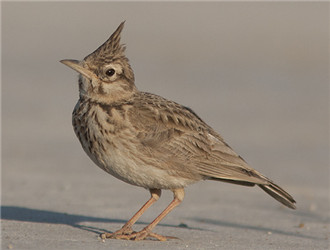
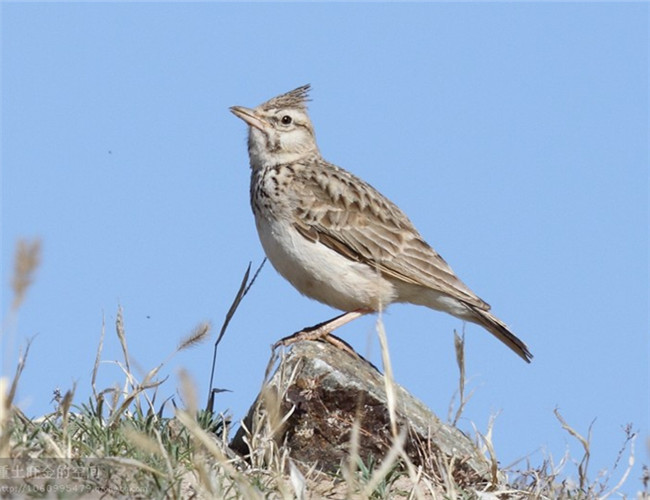
1 Crested Lark Breed Overview
The Crested Lark has 37 subspecies and is relatively large among passerines. Because it has a crest, long and narrow, its appearance is very distinctive. It is mainly distributed from Europe to the Middle East.
Chinese Name: Crested Lark
Latin Name: Galerida cristata
Also Known As: Crested Lark, Da’ale
Kingdom: Animalia
Phylum: Chordata
Class: Aves
Order: Passeriformes
Family: Alaudidae
Genus: Galerida
Species: Crested Lark (Galerida cristata)
Subspecies: 37
Named by and Year: Linnaeus, 1758
English Name: Crested Lark
2 Physical Characteristics of the Crested Lark
The Crested Lark is 17-18 cm long, wingspan 29-34 cm, weight 35-45 g. The relatively large Crested Lark has brown streaks and differs from the Skylark in its larger profile and pointed crest.
The Crested Lark has a crest, long and narrow. The upperparts are sandy-brown with near-black streaks, the tail coverts buff. The underparts are pale buff with dense near-black streaks on the breast. It looks stocky with a short tail and a slightly long, downcurved bill. In flight the wings are broad with rusty underwing; the tail is dark brown with yellow-brown sides. The juvenile has densely spotted upperparts. It differs from the Skylark in its larger profile and pointed crest, longer and more curved bill, less brown on the ear coverts, and no white trailing edge on the wing.
3 Crested Lark Habitat
The Crested Lark is mainly distributed from Europe to the Middle East, Africa, Central Asia, Mongolia, and China; in northwest China it is a resident and summer visitor. It is listed as Least Concern (LC) in the 2013 IUCN Red List ver 3.1.
The Crested Lark likes dry plains, open plains, coastal plains, wilderness, semi-desert, desert edges, grassland, low hills, wasteland, riverbanks, beaches, thickets, graves, barren slopes, farmland, and abandoned fields.
Outside the breeding season it is gregarious; it often walks on the ground or makes weak wavy flights. It sings on the ground, in flight, or while descending slowly with fluttering wings. It shoots straight up into the clouds; on the ground it is also good at running and, when disturbed, hides motionless, hard to spot due to camouflage. In flight it gives a clear ‘du-ee’ and a whistled ‘ee’ or ‘uu’. The song is a 4-6 syllable sweet, mournful short phrase, repeated with trills, slower, shorter, and clearer than the Skylark’s.
4 Crested Lark Feeding Guidelines
In northwest China the Crested Lark is a resident and summer visitor; widely distributed and omnivorous, it has many foods. If you keep one, refer to its wild diet.
The Crested Lark usually forages on the ground for insects and seeds. Mainly vegetarian but also insectivorous (omnivorous). Main foods are plants of Poaceae, Cyperaceae, Polygonaceae, Rubiaceae, and Lespedeza, plus some wheat and beans. It also preys on insects such as beetles, grasshoppers, and locusts.