Horned Lark
2 Photo Gallery
1 Horned Lark Breed Overview
The Horned Lark (Horned Lark) looks somewhat like a sparrow, especially with its understated dark gray plumage. Outside the breeding season it is mostly gregarious and has long been one of China’s famous cage birds.
In China, except for some subspecies that are winter visitors, the others breed in China and stay year-round as residents. The Horned Lark is mainly distributed in Iran, Afghanistan, Pakistan, the former Soviet Union, and Xinjiang in mainland China.
Chinese Name: Horned Lark
English Name: Horned Lark
Binomial: Eremophila alpestris
Kingdom: Animalia
Phylum: Chordata
Subphylum: Vertebrata
Class: Aves
Subclass: Neornithes
Order: Passeriformes
Family: Alaudidae
Genus: Eremophila
Species: Horned Lark (Eremophila alpestris)
Distribution: Iran, Afghanistan, Pakistan, the former Soviet Union, and Xinjiang in mainland China
2 Physical Characteristics of the Horned Lark
The ideal adult body length is about 16 cm, ideal weight 33-45 g, ideal wingspan about 33 cm. There are 42 subspecies. The male and female are roughly similar but differ on close inspection.
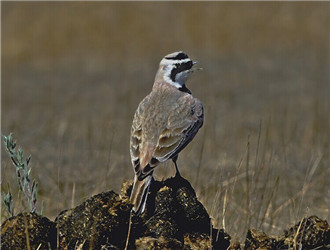
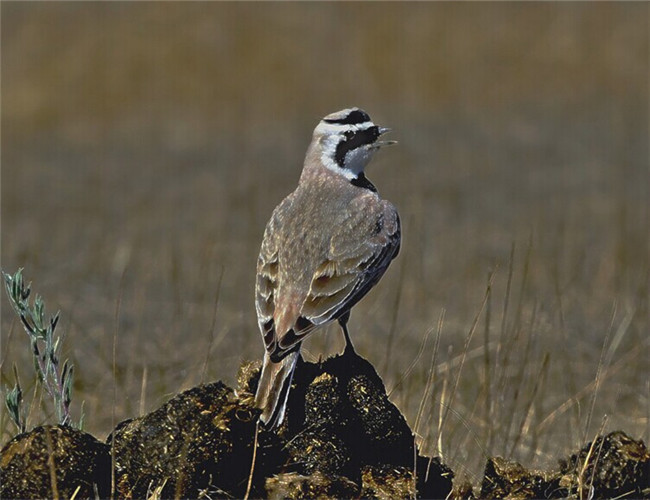
The male Horned Lark has a white or pale yellow forehead; just behind the white forehead is a broad black band, with 2-3 black elongated feathers at each end forming tufts extending back like two horns. The lores, cheeks, ear coverts, and bill base are black; the eyebrow stripe is white or pale yellow, connected to the white forehead. The hind crown and upper back are pinkish-brown, brown, or gray-brown; the back and rump are brown with dark brown streaks and sandy-brown or sandy-gray edges. The upper tail coverts are brown or brownish; the central tail feathers brown with brown edges, the outer tail feathers blackish-brown with faint white edges, the outermost pair nearly pure white, the next pair white only on the outer web or with a wedge-shaped white spot. The wings are brown; the first primary is white on the outer web, the rest have gray-white narrow edges, and the secondaries have white tips. The underparts are white with a black breast band.
The female is roughly similar to the male but with a shorter or less obvious crest and a narrower, smaller black breast band.
The iris is brown or dark brown, the bill black, the tarsus black or black-brown.
3 Horned Lark Habits
The Horned Lark is a typical omnivore; in the wild it feeds mainly on plant food, occasionally animal food such as insects, including barley, plant fragments, locusts, lepidopteran larvae, and beetle fragments.
In China, except for some subspecies that are winter visitors, the others breed and stay year-round as residents. Usually solitary or in pairs, sometimes in small groups of 3-5, especially during migration, the non-breeding season, and winter. Mainly active on the ground, not flying high or far. Good at short ground runs; when disturbed it stands still looking up; only when danger is near does it make a short flight. It sings well, especially morning and evening, with a clear, melodious song, often singing in the air. The flight call is a high, mournful ‘siit-di dit’. From a perch or in flight it gives a simple high hiss or a lively ‘tu-a-li, tioli-ti’ or similar.
4 Horned Lark Care
The Horned Lark is a common cage bird in China. If you want to keep it as a pet, be sure to tell males from females before buying. Its breeding season is usually May to August; in warmer low-elevation areas it starts earlier. It usually begins laying in mid-May. It breeds in high, barren, dry plains and cold deserts, descending to lower elevations and short grassland or lake shores in winter. The nest is built on the ground at the base of grass tufts or in shrubs.