Goldfinch
2 Photo Gallery

1 Goldfinch Breed Overview
The Goldfinch has 24 species worldwide, 5 in China, and prefers plains or hills as a resident. It usually breeds March to July. It is one of the common cage birds of northern China. Distributed across East Asia: the lower Amur in the Russian Far East, Japan, Korea, and northern Indochina; in China across the east, most of the northeast, north China, and central-southern China, west to Qinghai and the Yunnan-Guizhou-Sichuan line. Its food is mainly tree and weed seeds, also grain and insects.
2 Physical Characteristics of the Goldfinch
Female and male are very similar; the juvenile resembles the female. Adult female ideally 15-22 g, adult male 15-21 g. Female length 116-145 mm, male 119-140 mm.
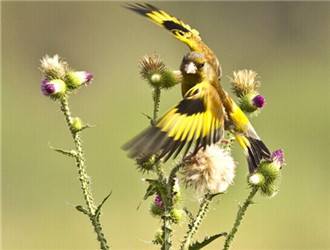
The male has gray-black lores and eye-ring, brownish-gray forehead, cheeks, ear coverts, and brow with a yellow-green tinge; crown to nape gray-brown with yellow-green feather tips. Back, shoulders, and inner wing coverts dark chestnut-brown with faint yellow-green edges; rump golden-yellow-green. Short upper tail coverts green-yellow; long ones gray with yellow-green. Central tail feathers black-brown with yellow bases and gray-white edges and tips; other tail feathers bright yellow at base, black-brown at tip, gray-white outer edges. Small, median, and greater coverts like the back; primary coverts and alula black with yellow-green bases and outer vanes, forming a bright yellow wing patch. Primaries black-brown with gray-white tips and bright yellow bases, making a large yellow wing spot; other flight feathers black-brown with gray-white edges and tips. Chin, throat, and cheeks olive-yellow; chest and flanks chestnut-brown with green-yellow or grayish; lower chest and belly center bright yellow; lower belly to vent gray-white; under-tail coverts bright yellow; under-wing coverts and axillaries bright yellow.
The female resembles the male but duller, with gray-brown crown to nape and dark streaks; less gold and more brown above, paler yellow below, less vivid than the male.
The juvenile resembles the female but paler, with clear dark streaks above and brown streaks below.
Iris chestnut-brown; bill yellow-brown or flesh-yellow; legs pale brown-yellow or pale gray-red.
3 Goldfinch Feeding Guidelines
A common cage bird in the north; any suitably sized cage works. It tolerates cold but not heat; keep indoors in winter, prevent heat in summer. What feeding points matter?
1. Food: millet, rape seed, perilla seed, etc.; without rape or perilla, feed millet plus greens and fruit. Chicks get vegetable puree and millet paste.
2. Amount and timing: birds have no crop, so do not overfeed; food must not spoil.
3. How to water chicks: place a water cup beside them; they drink on their own. Keep water abundant.
4 Goldfinch Care
Goldfinch (details)
The Goldfinch is very steady, perching long on wires; usually alone or in pairs, sometimes dozens or even hundreds. Breeding season usually March to August.
It breeds 2-3 clutches a year; 1-2 in the north, 2-3 in the south. In the north pairing starts as early as mid-to-late March, with courtship flights and chases. Nests are built in conifer saplings and broadleaf trees (poplar, fruit, banyan) or bamboo at 1.2-5 m, cup-shaped of twigs, grass, fiber, and roots, sometimes with cotton or feathers, lined with hair. Outer diameter 7-11 cm, inner 5-7 cm, height 5-8 cm, depth 3.5-5 cm; the female builds, the male helps carry material, 7-8 days. Then 4-5 eggs, elliptical, gray-green to pale green with rust or brown spots (denser at the blunt end), or green, green-white, duck-egg blue, or pale red with brown, black-brown, or purple spots; 17.0-19 x 12.4-14.5 mm, 1.6-1 g. One egg daily, before 7:00. The female incubates 13 plus/minus 1 day. Altricial chicks weigh 1.2-1.3 g at hatching, mostly naked with sparse gray down on head, back, and wings, pink skin; both parents feed them, nestling period 15 plus/minus 1 day.