Yellow-crowned Parakeet
2 Photo Gallery
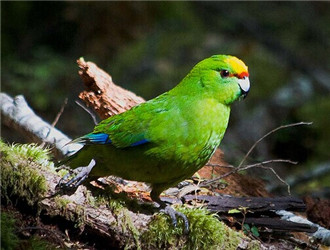
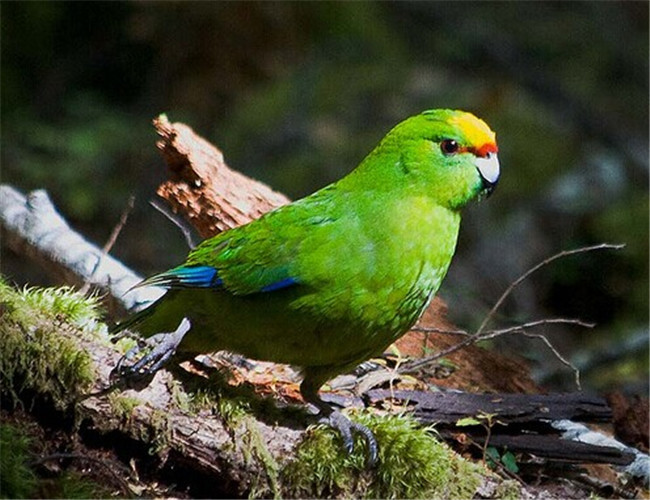
1 Yellow-crowned Parakeet Breed Overview
The Yellow-crowned Parakeet has two subspecies and habits much like other parrots; in the wild it is usually in pairs or small flocks, mainly distributed in New Zealand.
Chinese name: Yellow-crowned Parakeet
Latin name: Cyanoramphus auriceps
English name: Yellow-crowned Parakeet
Other names: Yellow-crowned Parrot
Kingdom: Animalia
Phylum: Chordata
Class: Aves
Order: Psittaciformes
Family: Psittacidae
Tribe: Platycercini
Genus: Cyanoramphus
Species: Yellow-crowned Parakeet
Subspecies: 2
Describer and year: Kuhl, 1820
2 Physical Characteristics of the Yellow-crowned Parakeet
By subspecies, length is 23-28 cm and ideal weight about 95 g. Small but looking full-bodied. A typical climbing bird, suited to grasping and climbing.
This parrot with a full bright-yellow forehead is endemic to New Zealand. The female is slightly smaller with a narrower head and bill; females and juveniles are slightly paler than males. The body is green; chest, belly, and inner wing coverts are yellow-green; a small red patch extends from the forehead to near the eye; the crown is golden-yellow; the lower back sides have red feathers; outer flight feathers are blue-purple; the bill is pale blue-gray with a black tip; the iris is red. The juvenile’s forehead patch is darker; iris pale or reddish-brown.
3 Yellow-crowned Parakeet Living Habits
In the wild it likes forests of various heights and preens with fellow parrots. Sometimes seen in orchards or farmland. Wild diet: plant buds, flowers, seeds, insects, etc.
In breeding season it is mostly in pairs or small groups on outer branches, wary of small predators so rarely on the ground; only on predator-free islands does it feed on the ground. It stays near the nesting tree most of the year, not very wary, approachable at a distance. Call similar to the Red-fronted Parakeet.
4 Yellow-crowned Parakeet Care
It breeds oviparously; with human conservation, breeding is effective. Few remain in the wild, so home keeping is declining.
Usually it gathers in woods, sometimes in tree holes, nesting on mossy ground with feathers and weeds, 5-9 eggs per clutch, parents feed chicks about 20 days.
Captive breeding: a wooden box 3.6 m long x 0.9 m wide x 1.8 m high, plus an open area for the parents. Separate the male from chicks after hatching, as males may kill young. Not hard to hand-feed; mixed plant seeds, apple, pear, and grape are suitable foods.