Ring-throated Finch
2 Photo Gallery
1 Ring-throated Finch Breed Overview
The Ring-throated Finch is naturally lively and very curious, and during the breeding season likes to move about in pairs or flocks. Because its place of origin is close to where people live, it is very close to humans and therefore easy to keep and breed. It likes to weave ball-shaped nests from grass and feathers, and sometimes uses old sparrow or swallow nests.
Chinese Name: Ring-throated Finch
Kingdom: Animalia
Phylum: Chordata
Subphylum: Vertebrata
Class: Aves
Subclass: Neornithes
Order: Passeriformes
Family: Estrildidae
Species: Ring-throated Finch
Distribution: Native to Africa
2 Physical Characteristics of the Ring-throated Finch
Even as a hatchling the Ring-throated Finch is very bold, and its clever, active nature makes it beloved; an adult is about 11 cm long, entirely yellow-brown and very brightly colored. Extremely beautiful, they live on average about 5 years.
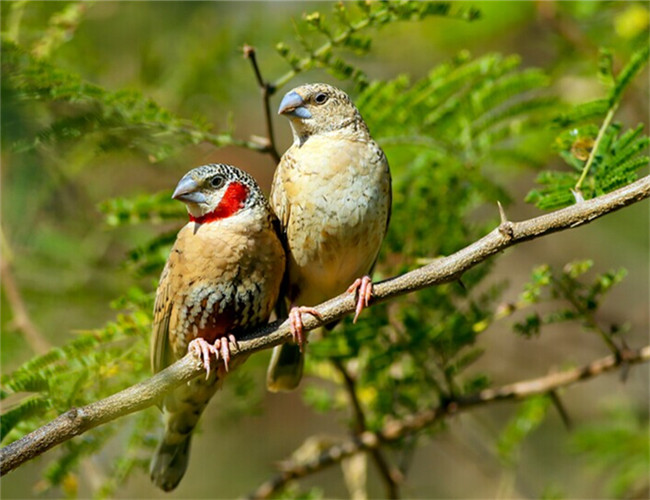
The male Ring-throated Finch has red feathers on the neck that the female lacks. The sexes are similar in color, with a yellow-green back and yellow chest and belly. In young males the red on the throat is paler than in adults, but the body color is about the same.
3 Ring-throated Finch Feeding Guidelines
The carefree Ring-throated Finch is naturally very bold and unafraid of strangers; it not only adapts quickly to new surroundings but also gets familiar with its new owner fast. So keeping and breeding this finch is easy. They like to hide themselves, which aids their growth.
In captivity the Ring-throated Finch can be fed millet and other smaller grains, and also some lettuce. Regularly give live food, especially during breeding when insects are important. Its environment is best with some plants.
4 Ring-throated Finch Care Tips
The Ring-throated Finch is particular about hygiene, especially when eating. In captivity keep the temperature around 15 degrees C, and during breeding preferably above 18 degrees C. The petite finch is very lively and gets along peacefully with humans. Though its ancestors are on the distant African continent, it adapts quickly once introduced and is an elegant yet not delicate ornamental bird.
During breeding, to avoid squabbles between the pair, place several nest boxes at different spots around the aviary, and prepare boxes with an opening at the front. They love building nests themselves. Owners should especially watch for egg-binding in females, which is common and needs care.