Red-fronted Parakeet
2 Photo Gallery
1 Red-fronted Parakeet Breed Overview
The Red-fronted Parakeet (Red-fronted Parakeet) has colorful, brilliant plumage. It is a typical perching bird, usually active in pairs or small flocks in the wild, mainly distributed across New Zealand and several nearby small islands.
Chinese Name: Red-fronted Parakeet
English Name: Red-fronted Parakeet
Binomial: Cyanoramphus novaezelandiae
Kingdom: Animalia
Phylum: Chordata
Class: Aves
Order: Psittaciformes
Family: Psittacidae
Tribe: New Zealand Parakeets
Subspecies: 8
Distribution: Islands of northern and southern New Zealand
2 Physical Characteristics of the Red-fronted Parakeet
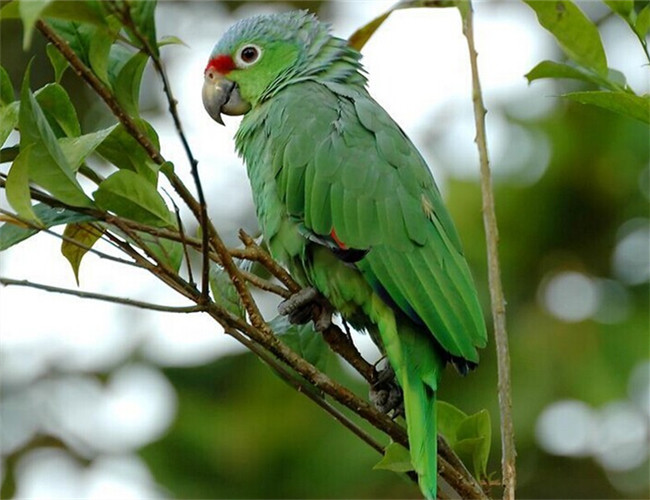
Most parrots are green, and the Red-fronted Parakeet is no exception. This parrot is about 28 cm long as an adult, with an ideal weight of 50-113 g. Average lifespan is about 6 years.
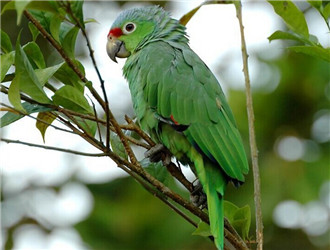
The bill is strong and powerful, hooked, with a movable joint on the upper mandible and a cere at the base. The tongue is thick and muscular. The feet are short and strong, zygodactyl (two toes forward, two back), suited to grasping and climbing. The body is green; the breast, belly, and inner tail coverts are yellow-green; the forehead, crown, and stripe behind the eyes are red. The plumage is brilliant with powder down. The lower back sides also have red feathers; the outer flight feathers are blue-purple; the bill is pale blue-gray with a black tip; the iris is red. The female has fewer red head feathers; her iris is red-brown and her tail shorter.
3 Red-fronted Parakeet Habitat
The Red-fronted Parakeet is not expensive; besides a reasonable price, its quietness and ease of breeding are advantages. It is not afraid of strangers and adapts quickly to new owners. Its quiet, gentle nature and moderate size make it a good home pet.
The Red-fronted Parakeet inhabits New Zealand forests of all elevations, especially extensive woodland; shrubland, grassland, forest edges, and coastal areas on small islands are also its range. It prefers forest edges and open areas, mainly on small islands’ forests and surrounding open shrubland and grassland.
4 Red-fronted Parakeet Care
In the wild the Red-fronted Parakeet is usually active near water, often traveling in pairs or flocks during breeding. Its quiet, stable nature and moderate price make it popular. Keeping a pair for breeding is a good first choice.
The Red-fronted Parakeet mainly eats leaves, plant buds, flowers, nectar, fruit, berries, many insects, and animal remains or carrion; sometimes it picks up small stones. Along the coast it also eats seaweed and mussels.
The breeding season is mainly October to December but can occur year-round; it nests in tree hollows. On islands near New Zealand with fewer trees, when hollows are scarce it nests in rock crevices and burrows, laying about 5 eggs. Before European settlers arrived its numbers were large; now some subspecies number only a few thousand or even hundreds, and the world population may exceed 15,000 but it often hybridizes with the Yellow-fronted Parakeet, so some are not pure.
In captivity, egg-laying reproduction has a high success rate; they can breed at about 5 months but it is recommended to wait until fully mature (about 1 year). A mature pair usually has a strong breeding urge, can breed year-round, and produce several clutches a year, 4-9 eggs (usually 5), incubation 19-20 days, feathers grown in about 35 days. If the female lays a second or even third clutch before the young leave, continuous breeding is not recommended; if it happens, hand-rear the chicks to reduce the parents’ burden.