Red Lory
2 Photo Gallery
1 Red Lory Breed Overview
The Red Lory is beautiful from every angle and is very common in Taiwan, especially in bird shops where Red Lory chicks are often seen. It is a fairly noisy parrot whose occasionally piercing calls can be unbearable, so before buying an adult, first assess whether your home environment suits such a noisy species.
Many in Taiwan successfully breed the Red Lory; choosing mature, captive-bred birds yields quick results with low difficulty, even in a small cage. They lay 2 eggs per clutch, incubate about 26 days, and fledge in 7 to 9 weeks. Chicks should be pulled for hand-rearing at 3 to 4 weeks, or the parents may attack them. They can breed year-round.
Chinese Name: Red Lory
Chinese Alias: Red Ling
English Name: Red Lory
Binomial Name: Eos bornea
Kingdom: Animalia
Phylum: Chordata
Subphylum: Vertebrata
Class: Aves
Subclass: Neornithes
Order: Psittaciformes
Family: Psittacidae
Subfamily: Loriinae
Genus: Eos
Subspecies: 2
Distribution: Wallacea, the region east of the traditional Wallace Line and west of Papua New Guinea, including Indonesia’s Sulawesi, Nusa Tenggara, Southwest Islands, Maluku (Moluccas), and East Timor.
2 Physical Characteristics of the Red Lory
The Red Lory has gorgeous, colorful plumage that beats many related parrots in appearance. Well kept, it lives up to 16 years, no less than a dog or cat. An adult is about 29 cm long and ideally weighs around 170 g.
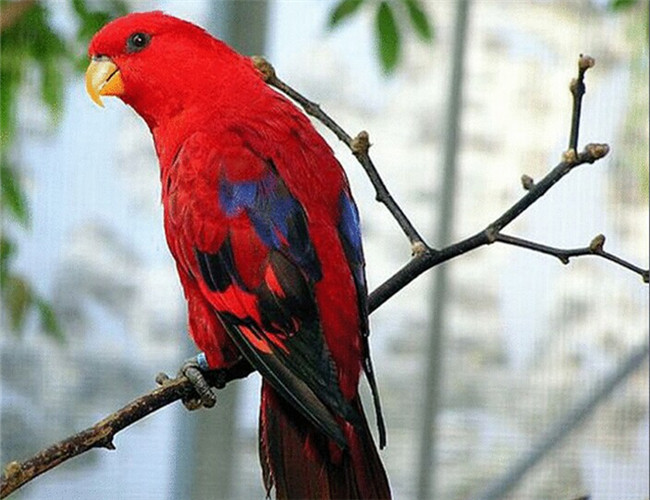
In the adult Red Lory, the head and neck are entirely red. The primaries are black, the secondaries and tertials blue, and all tail feathers reddish-brown. The iris is red and the legs gray. Young birds are duller than their parents: the main flight feathers are blue-gray, the ear coverts sometimes have blue, and the perianal area and legs have scattered small blue spots. The belly feathers often have dark blue edges. The iris is brown.
3 Red Lory Living Environment
Because the Red Lory has a sharp, hard beak and loves to chew, some beginners are at a loss; it is advised to use a metal or bite-resistant cage. The specific sizing and the bird’s environmental needs are detailed below.
The cage should be about 80 cm long, 40 cm wide, and 50 cm high. A metal perch stand can also be used; perches should be hardwood or metal rods, and food and water dishes should be ceramic or metal. Pay special attention to hygiene: clean dishes daily, change cage sand 1 to 2 times a week, and disinfect the room and cage often. In winter keep warm with indoor temperature not below 16 degrees C; in summer above 30 degrees C, improve ventilation.
For breeding birds in winter, keep the room above 20 degrees C with relative humidity of 45 to 50 percent, and maintain air circulation.
4 Red Lory Feeding Guidelines
The Red Lory is quite active; active parrots tend to be noisy, so before keeping one you must accept its noise level. It breeds readily and can breed year-round.
Feed the Red Lory corn, rice, peanuts, small hemp seeds, sunflower seeds, and a steamed cornmeal or mixed-flour mash, plus a little fruit and vegetables. During breeding and winter, increase the proportion of peanuts and hemp seeds; in summer feed more fruit.