Golden Conure / Queen of Bavaria’s Conure
2 Photo Gallery
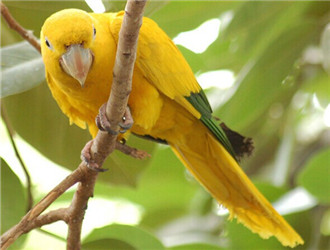
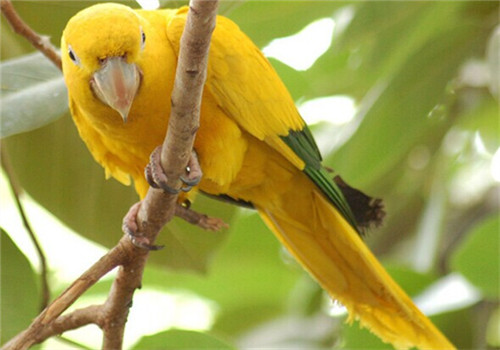
1 Golden Conure Breed Overview
The Golden Conure has very special plumage: except for green wings, its entire body is golden yellow, dazzling and beautiful. It is one of the rarest, most beautiful, and largest of the conures.
The Golden Conure is a typical climbing bird, usually active in pairs. It is mainly distributed in the southern Amazon basin of northeastern Brazil.
Chinese name: Golden Conure
Other Chinese names: Golden Parakeet
English name: Golden Conure / Queen of Bavaria’s Conure
Binomial name: Aratinga guarouba
Kingdom: Animalia
Phylum: Chordata
Class: Aves
Order: Psittaciformes
Family: Psittacidae
Tribe: Arini
Distribution: southern Amazon basin of northeastern Brazil
2 Physical Characteristics of the Golden Conure
The Golden Conure differs from other parrots in its very bright plumage; the golden body is eye-catching, with green wings. An adult is about 34 cm long and weighs about 270 g.
Around the eyes is a ring of white bare skin; the bill is flesh-colored with a slight bluish tip; the iris is brown. The juvenile is not the dazzling gold of the adult but mixed with much olive green, especially on the head; it gradually turns all gold at about 20 months.
The Golden Conure is a typical climbing bird with a strong, hooked bill, a movable upper jaw joint, and a cere at the bill base. It has a thick muscular tongue, short strong feet, and zygodactyl toes (two forward, two back) suited to grasping and climbing.
3 Golden Conure Habitat
The Golden Conure’s main appeal is its noble, striking appearance, a dream bird for many enthusiasts. Providing a good living environment is essential.
Keep it with care and patience, especially watching for behavioral changes. It adapts quickly to new environments and owners, then becomes very robust, loves bathing, and needs fresh branches to chew; hand-reared youngsters are tame and cute, and toys should be provided.
The Golden Conure actually fears heat; heat harms it far more than cold. Above 35 C most become restless; above 37 C weaker individuals may die of central nervous paralysis. Prevent heatstroke: ventilate in summer, keep the cage out of strong sun, give fresh produce, use AC or ice if possible, and mist the bird when overheated.
4 Golden Conure Care
Many choose the Golden Conure for its beauty, but its color changes by stage: the newborn is dark green mixed with gold, turning fully gold (except wings) after about 20 months. Feather-plucking often appears in breeding season; good interaction with the owner as a chick reduces it. Good mimic ability.
In the wild, breeding is usually in the rainy season (December to April), nesting in tree holes 15-30 m high; they often breed communally, usually more females, with a record of 14 chicks in one nest cared for by 6 adults; usually 2-4 eggs per clutch.
The Golden Conure is quite gentle; there are records of wild ones fostering other species’ young. Captive breeding starts around November; provide a thick wooden nest box 30 x 40 x 40 cm. Well cared for, they are prolific and easy to breed; both parents take turns incubating, 3-5 eggs per clutch, incubation about 23 days, fledging about 7 weeks, after which parents quickly push youngsters out and prepare the next clutch. Wild ones differ: the male guards outside while the female incubates, and after fledging the parents stay with the young teaching survival until they join the flock. Captive breeding recorded from age 4 and up.