Blue-crowned Lory
2 Photo Gallery

1 Blue-crowned Lory Breed Overview
The Blue-crowned Lory (Vini australis) has strikingly beautiful head plumage. It shares many traits with the scaly-breasted lorikeet, and the special common feature is a brush-like tongue that helps the parrot reach deep into flowers to obtain food.
The Blue-crowned Lory also has a special internal structure: a particular digestive enzyme exists in its body to help break down food. However, because this lorikeet has no need to digest grain feed, its gizzard is much weaker than that of other parrots at handling hard foods.
Chinese name: Blue-crowned Lory
Other names: Blue-crowned Parrot
English name: Blue-crowned Lory
Binomial name: Vini australis
Kingdom: Animalia; Phylum: Chordata (Phylum Chordata)
Subphylum: Vertebrata
Class: Aves
Subclass: Neornithes
Order: Psittaciformes
Family: The order Psittaciformes contains only the family Psittacidae, but it is extremely diverse.
Subfamily: Loriinae
Genus: Vini
Species: Blue-crowned Lory
Distribution: Across the islands of the Pacific, including Taiwan, China, the Dongsha, Xisha, Zhongsha, and Nansha Islands, as well as the Philippines, Brunei, Malaysia, Singapore, Sumatra and Java in Indonesia, and Papua New Guinea. Mainly the Fiji Islands of the South Pacific.
2 Physical Characteristics of the Blue-crowned Lory
The Blue-crowned Lory is a relatively small parrot, about 19 cm long as an adult, with an ideal weight of 47-52 g. The overall plumage is very vivid, giving a pleasant general appearance.
The Blue-crowned Lory’s beak is longer than that of typical parrots, and its slender tongue bears brush-like hairs, called a brush tongue, which lets the parrot reach deep into flowers for food.
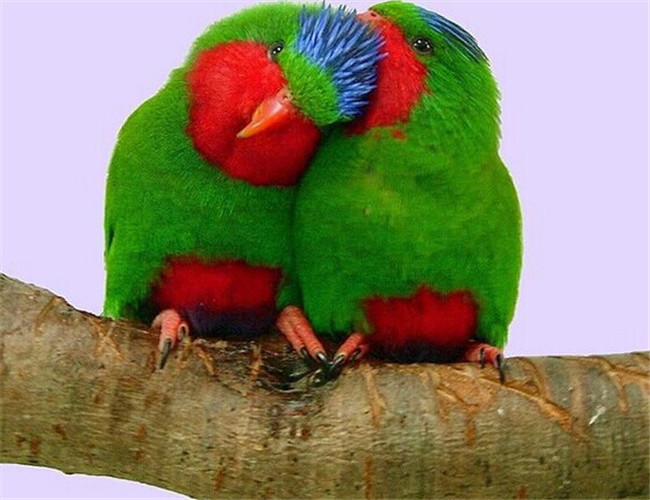
The Blue-crowned Lory is not commonly kept in captivity internationally, and males and females show no obvious external differences and there are no close subspecies. The cheeks are green, the crown is blue, and there are large red patches on the throat and belly; the beak is dark yellow, the eyes are yellow, and the thighs are blue or purple.
3 Blue-crowned Lory Living Environment
The Blue-crowned Lory is fairly common in its native range, but its numbers have declined because of predation by rats. It mainly inhabits woodlands, palm groves, coastal areas, mountains, and farmland with flowering trees, and is migratory.
Very few are kept in captivity. Caged birds are not noisy and enjoy bathing. It is best not to acquire them in winter, they demand high environmental hygiene, and owners should pay close attention to sanitation to avoid disease. Newly acquired birds are sensitive at first and need time to adjust to temperature, environment, and food before they settle.
4 Blue-crowned Lory Care
The Blue-crowned Lory usually begins breeding around July each year. Males and females show no obvious external differences and there are no close subspecies; they live on small islands and their wild numbers are a cause for concern as they decline year by year.
Information on captive breeding is quite limited. They can be bred in groups, but pairing works better. Some animal protein can be added during breeding; excessive human disturbance during this period may lead parent birds to kill the chicks, so do not frequently open and inspect the nest box. To breed successfully, avoid all unnecessary disturbance. They lay about 2 eggs at a time, hatching in about 23 days, with chicks fledging in about 7-8 weeks.