Triangle Butterflyfish
2 Photo Gallery

1 Breed Profile
The Triangle Butterflyfish is native to the coral reef waters of the Indian Ocean and is very beautiful. As a marine fish it is somewhat difficult to keep, so providing suitable water conditions is important.
Chinese name: Indian Ocean Triangle Butterflyfish
English name: Triangle butterflyfish
Binomial: Chaetodon triangulum
Geography: Distributed in the coral reef waters of the Indian Ocean, ranging from Madagascar to the Andaman Sea and the western Indonesian archipelago.
Climate: tropical
Endangered status: not listed in the IUCN Red List
Reproduction: broadcast spawner
2 Appearance
The adult maximum length is 16 cm. Dorsal spines: 11-12; dorsal soft rays: 23-26; anal spines: 3; anal soft rays: 20-22. It is somewhat territorial, so choose tank mates carefully.
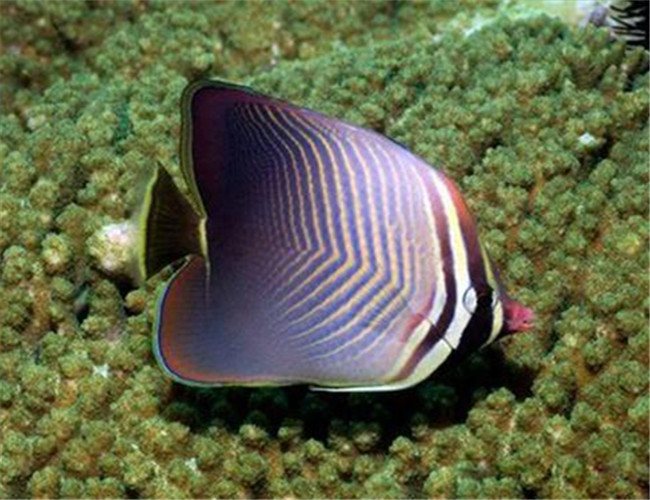
The adult body is oval, strongly compressed; the head profile is straight, slightly concave at the nose. The snout is pointed but not tubular; the front nostril has a flap. The preopercle has fine serrations; the gill membrane joins the isthmus. The body has medium scales and a single dorsal fin. The body is milky white with a dozen gray-blue arrow-shaped stripes; the head has three orange-red to black arcs – the first on the snout, the second an eye band narrower than the eye diameter extending to the front of the pelvic fins, the third from behind the dorsal spines through the gill cover to the rear edge of the pelvics; between these black bands the body is white to pale yellow. The rear edges of the dorsal and anal soft rays are yellow-green; the caudal fin has a white rear edge. It is very similar to the Pacific Triangle Butterflyfish (Chaetodon baronessa), differing at the caudal fin: the Indian Ocean form has a golden-yellow arrow mark near the caudal peduncle, absent in the Pacific form.
3 Husbandry
Captive care is somewhat difficult. As a butterflyfish it is marine, so matching the water is key. In the wild it lives at 22-26 C, so keep below 28 C and pH 8.1-8.4.
It inhabits lagoons and seaward reefs at 1-25 m depth; adults live among Acropora thickets, especially Staghorn Acropora. Usually in pairs, somewhat territorial; juveniles live alone among coral branches. It is distributed in the Indian Ocean coral reefs from Madagascar to the Andaman Sea and western Indonesia.
4 Feeding
As a coral-polyp feeder, train it to accept fresh and frozen shrimp meat. Always disinfect such food before feeding.
Omnivorous, a coral-polyp feeding ornamental. Wild ones live in lagoons and seaward reefs at 1-25 m, adults among Acropora thickets, especially Staghorn Acropora.