Aegean Killifish
2 Photo Gallery
1 Breed Profile
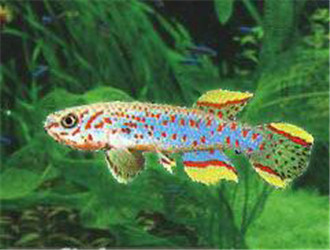
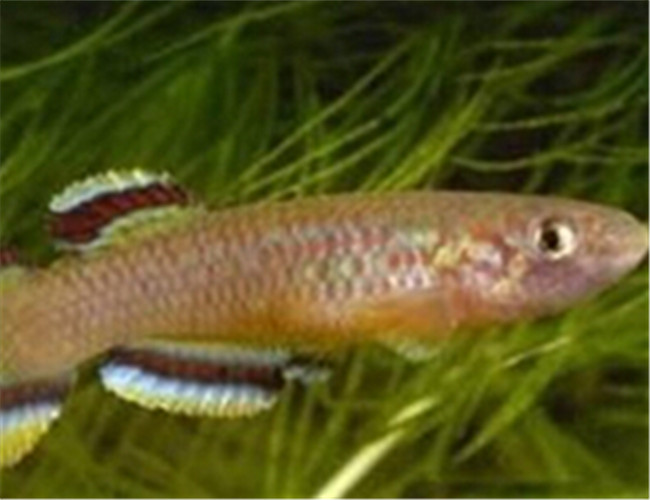
The Aegean Killifish (Aphyosemion celiae) is native to West Africa, shaped like the harp killifish, 6-7 cm long. The caudal fin is slightly long and broad, not forked, tips not extended. Base color pale green-yellow, changes with environment; dorsal and anal fins have black bands; the caudal pattern is beautiful. Males have orange bands on caudal and anal; females’ flag-like fins are less colorful. Males are more beautiful when breeding. Likes weakly acidic water and higher temperature, optimal 24-28 C; eats bloodworms, artemia; hardy, robust, easy.
English name: Aegean Fish
Type: tropical freshwater fish
Origin: West Africa
Reproduction: oviparous
Water: pH 6.5, H 3, T 25 C, L 6 cm, V 40 L
Care level: easy
Suitable temperature: 24-28 C
2 Morphology
Likes weakly acidic water and higher temperature, optimal 24-28 C; food mainly bloodworms, artemia; hardy, robust, easy. Can mix with small fish; eyes superior. Hardy. It has black bands; when breeding, the male spreads pectorals before the female, approaches to spawn, then quickly fertilizes. This is the easiest of the family to breed successfully.
Shaped like the harp killifish, 6-7 cm. Caudal slightly long-broad, not forked. Base pale green-yellow, changes with environment; dorsal/anal with black bands; caudal pattern beautiful. Males more vivid than females. Adults 6-7 cm. Likes weakly acidic water, optimal 24-28 C; live food; hardy, easy.
3 Care
As a tropical fish, know the species’ habits to build its environment. Care includes water, feeding, heating; understand habits for healthy fish.
Equipment besides tank and filter: water circulation, heater, aerator, lighting, pump. For one tank: small circulation pump, 100-200 W heater, single/double air pump, fluorescent, small submersible pump. Multiple tanks more complex. Filtration: in-tank or external; small tanks use in-tank or low-power pump, large use external. Heaters: auto thermostats 100-1000 W glass or stainless; large farms use boiler heating, AC, radiators.
Aerators: single/double/quad air pumps, turbine oxygenators. One tank: single pump; multiple: double/quad. Made of plastic, using rubber diaphragms; replace when cracked or aged. Large scale: turbine oxygenator, metal, low failure, long life. Auxiliary: air stone, tubing.
Lighting mainly fluorescent, also halogen, mercury. Single tank may use underwater color lamp, a sealed glass tube stuck to the wall, giving red/blue/green/white for scaping.
Pumps are small all-plastic submersibles, 200-1000 W, head 5-10 m, stuck to wall, draining a tank in minutes, safe.
4 Environment Requirements
Base pale green-yellow, changes with environment; dorsal/anal black bands; caudal beautiful; males orange bands; females less; males prettier breeding. ‘Partial water change’ is a common effective method: turn off heater/pump, wipe algae, let settle 15 min, siphon 1/4-1/3 of bottom waste, then slowly add same-temperature new water along the wall.
Full water change replaces all water, simplest but laborious, especially with decor. Cut power, remove fish and decor, drain, rinse tank, replace decor, add new water.
5 Feeding Notes
Keep 24-28 C; appetite strong, growth fast, stable. Foods: daphnia, tubifex, infusoria, mealworms, small live fish, pellets. Many species, sizes vary, so food differs. For 3-12 cm, mainly daphnia with tubifex/bloodworms/mealworms as supplement. Over 12 cm, choose larger food: bloodworms, tubifex, mealworms, small live fish. Mostly animal; small ones can be trained to pellets; few are plant-based.
Feeding frequency and amount by size and count. Home: 1-2 times daily, eat in 5-10 min. Bulk: 2-3 times; breeders 3-4 times. Small appetite; feed 70-80% full, more frequent meals aid growth. Most eat daphnia mainly; when daphnia, 10-30 min; when tubifex, 5-10 min, 2-3 times, rinse well; when small fish/shrimp, frequent small meals; when changing food, increase gradually; fast 1-2 days before transport.