Kissing Gourami
2 Photo Gallery
1 Breed Profile
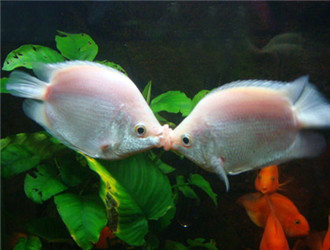
The Kissing Fish, also called the Kiss Mouth Fish, is a common tropical ornamental and very well known. Many think the ‘kissing’ is a symbol of love, but it is actually territorial fighting.
Chinese name: Kissing Gourami
Binomial: Helostoma temminckii
Kingdom: Animalia
Class: Actinopterygii
Family: Helostomatidae
Species: Kissing Fish
Origin: Indonesia, Thailand, Sumatra in Asia
Suborder: Anabantoidei (Climbing perch suborder)
Foreign name: kissing fish
Distribution: Thailand, Indonesia, Sumatra
Phylum: Chordata
Order: Perciformes
Genus: Helostoma
Also known as: Kissing Gourami, Kiss Fish, Kiss Mouth Fish
2 Husbandry
With normal stable conditions it is easy to keep. Many think it is romantic, but the kissing is territorial fighting.
It likes tropical rivers and is used as a food fish in its origin. Not demanding about water; not strongly schooling; swims slowly, stately, charming. Usually very gentle and lively, so not for fish that like quiet. It swims all layers but rests at the bottom. Omnivorous; though large, it ignores big daphnia and instead opens its big mouth long to ‘drink’ small daphnia – a special feeding style. It also sucks algae off glass and plants with its thick lips, so one is often kept per tank as a ‘tank cleaner’.
Robust, no special water needs, easy and disease-resistant. Grows fast; mature in about 15 months, a large high-yield fish. Egg-laying, easy to breed, but sexing is hard: only breeding females show a swollen belly full of eggs; otherwise they look identical.
3 Feeding
Omnivorous, not picky; eats whatever given. Robust, fast-growing, likes to graze algae on plants and glass, hence the ‘cleaner’ nickname.
Easy to keep, no strict water needs, likes weakly acidic soft water, lives well above 18 C, never attacks other tropical fish; swims slowly, elegant, very ornamental. Body slightly red-white like a peach blossom, so some call it Peach Blossom Fish. Easy; no special water needs, 22-26 C. But it grows large, so use a bigger tank. Gentle, schooling in all layers, good with others. Omnivorous, not picky: mealworms, chopped earthworms, pellets – eats whatever fed. Fast-growing, resistant, rarely sick.