Swallow Beauty
2 Photo Gallery

1 Breed Profile
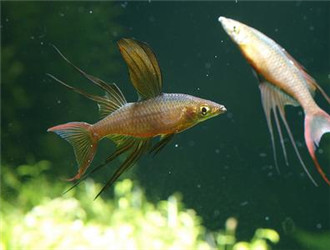
The Swallow Beauty, whose full name is the Swallow Beauty Lantern Fish, derives its name from pelvic fins that have mutated into two long, pointed fins shaped like a swallow. It was first discovered by a German in 1973.
Chinese name: Swallow Beauty Lantern Fish
Also known as: Thread-fin Rainbowfish, New Guinea Rainbowfish
Kingdom: Animalia
Distribution: Australia, western Ireland
Reproduction: oviparous; cannot be bred artificially
Suitable temperature: 26-28 C
2 Appearance
The most distinctive feature of the Swallow Beauty is its pelvic fins, which have mutated into two long, pointed fins shaped like a swallow. Although its body form is unique, its temperament is equally gentle, so it can be kept with small tropical fish. Its head is small and pointed, as is its mouth.
The most impressive aspect of the Swallow Beauty is its fin shape. In mature males the first dorsal fin forms a clear fan of six rays; the second dorsal and anal fins extend into flowing filaments. The body color is mainly metallic silver, sometimes showing a slightly pinkish tone. The whole body shimmers with rainbow light; when the fins are not spread you see them swimming with long trailing fins, and when spread the dorsal fin stands high – nearly twice the body height – while the pelvic and caudal fins extend gracefully backward.
3 Husbandry
Because of its gentle nature and unique shape, the Swallow Beauty is beloved by aquarists. It is also easy to keep: given a pH of 5.8-6.5 and a temperature of 26-30 C, it adapts well.
Its natural habitat is slow-flowing, clean water richly covered with vegetation. It suits an aquarium with plants and driftwood, and because of its gentle nature it can be mixed with small fish. Generally a 40-60 W fluorescent lamp can be installed, lit 6-10 hours per day.
4 Feeding
The Swallow Beauty is not hard to keep; once stable water is provided, balanced food is enough. Feeding is also easy and requires no difficult taming tricks.
Its food is mainly live or frozen. Both indoor and outdoor breeding successes have been recorded. Experienced hobbyists note a few tricks for breeding, the most important being to provide a dense clump of Java moss as the spawning medium. Fry hatch after a few days and are extremely tiny – they must be fed infusoria and very small microorganisms, which is the main cause of fry-rearing failure. Those interested in breeding should pay special attention.