Silver Arowana
2 Photo Gallery

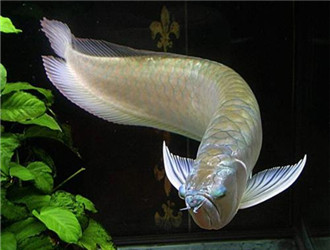
1 Species Overview
The silver arowana gets its name from its body shape, which resembles the ancient dragon, and its silver scales. Juveniles are rather bluish and reflect beautiful light as they swim. Adults reach 90–100 cm, making it a large ornamental fish.
Chinese name: Silver arowana (银龙鱼)
Latin name: Osteoglossum bicirrhosum
Other name: the double-barbel bone-tongue fish
Kingdom: Animalia
Phylum: Chordata
Subphylum: Vertebrata
Family: Osteoglossidae (bone-tongue family)
Distribution: Amazon River and Guyana
Adult length: 90–100 cm
2 Appearance
Because the silver arowana is kept in Asia as a feng shui fish, it is very popular with aquarists. The arowana’s shape resembles the dragon of ancient myth, and the silver arowana’s coloration is special, so it is one of the main ornamental fishes in China.
The silver arowana has a long, ribbon-like, laterally compressed body with a fan-shaped tail; the dorsal and anal fins are band-like and extend back to the base of the caudal peduncle. The lower jaw protrudes beyond the upper, and a pair of short, thick barbels grows at the snout. Five rows of large scales are neatly arranged on its broad body, shimmering silver in the light. The fins reflect an orange or reddish sheen under light. Juveniles are bluish, with red-blue edges on the dorsal and anal fins. The golden arowana has gold-edged scales and gold-red fins. The red arowana is golden-yellow with gold-red scale edges, deep-red patches on the mouth and gill covers, and deep-red fins. The silver arowana is silvery-white, while the black arowana is silvery-white with a slight bluish-purple tint and a blue-black back.
The silver arowana has a very slender, laterally thin body. The mouth is positioned on top, with the gape extending back to the rear edge of the eye socket. The lower jaw protrudes more than the upper, and several thread-like lateral-line organs sit in a row at the front. A pair of barbels grows at the snout tip; in wild individuals that roam freely in nature the adult barbels can reach 3–4 cm, but under captive breeding growth is restricted and they often reach only 1–2 cm. The lower jaw’s dentary is well developed, and the conical teeth arranged comb-like between the jaws are very small and sharp, with narrow gaps between them. Not only the premaxilla but also the dentary, the pterygoid of the palate and the tongue bones are all well developed—this evolved to crush large crustaceans and beetles in one bite. The jaws emphasize prey-catching function over bite force.
The gill rakers are developed into spines. The large round eyes sit near the front edge of the upper jaw and vision is excellent. The snout is very short. The nostrils are above and in front of the eyes, close to the snout tip. The dorsal and anal fins are very long; the anal fin starts ahead of the dorsal. The first ray of the extended pelvic fin even passes the anal-fin origin. The pectoral fins are well developed. The body is covered with five rows of large, beautiful cycloid scales. The lateral line runs from above the rear edge of the gill cover behind the head all the way to the caudal peduncle. Body depth is about one-fifth of the length. A 90 cm, 5–8 year-old male is much deeper-bodied than a female, with the mid-body approaching 2 cm in depth. Such a powerful shape is unmatched even by the most expensive Asian arowanas—unfortunately, silver arowanas with this wild form are now hard to find.
Silvery-white is subtly mixed into an overall grey-green body. If juveniles, sub-adults and adults in captivity are all fed krill, the carotenoids tint the dorsal and anal fins with red bands and even turn the scale edges on the flanks red. As adults, the red fades to a smoked-silver or platinum-silver; the white edges of the dorsal and anal fins intensify, making the already large body look even bigger. Females are slightly darker, appearing duller, while the back is grey-green in both sexes and pleasant as a background tone. However, the strong mirror-like sheen on the flanks makes males and females hard to tell apart in light except in the breeding season. A few captive individuals show a total albino color variant known as the platinum-silver arowana.
3 Tank & Habitat
The silver arowana is robust, grows fast and eats enormously, so it should not be mixed with other ornamental fish. Use a large aquarium and keep it covered. It likes weakly acidic or neutral soft water, and substrate should not be laid on the tank bottom.
The silver arowana needs a lot of light—ideally about 4 hours of illumination daily; other arowanas do best with around 8 hours. Some hobbyists, when keeping silver arowanas, like to use red light for a better effect. The best light for arowanas is natural daylight; long-term use of artificial light darkens the back.
Arowana fry are too large for a planted tank. With a big tank, filtration becomes the key issue. Suitable filter systems for arowanas include top filters, external canister filters, top + undergravel filters, and overflow filters. When setting up an arowana tank, also consider adding a wave maker (current pump)—the benefits are great: it creates strong water flow, raises dissolved oxygen, keeps the fish exercising to maintain its graceful shape, and, importantly, helps prevent gill curl; if gill curl occurs, the gill can be trimmed, and using the wave maker during recovery helps the growing gill lie flat.
4 Feeding
The silver arowana is a large ornamental fish, robust but with a huge appetite; it will swallow small fish, so mixing with other ornamental fish is not advised. In captivity it is fed mainly animal-based foods. So how do you feed it scientifically?
Because the silver arowana can crash into the tank corner and hurt itself when feeding too vigorously, it is best to drop food in the middle of the tank. It is a carnivore; most silver arowanas eat frogs, loaches, crickets, goldfish, grasshoppers and small shrimp. Feeding also affects color: for example, feeding a red arowana red platies or small shrimp helps enhance its red color because they contain red pigment. Fry under 12 cm are just starting live food—feed newly molted white mealworms, small shrimp (always remove head and tail, preferably peeled into shrimp balls to avoid the hard shell harming the gut), and bloodworms as easy-to-eat foods. Feed small amounts often, four times a day. Silver arowanas around 15 cm can eat normal mealworms and small shrimp (best with the rostrum removed) and 1.5 cm small fish. At this stage they grow fast and eat astonishing amounts, so increase feeding frequency and amount as appropriate.
Silver arowanas over 20 cm can be fed larger fish, shrimp, loaches and meat chunks. Various live insects also work and are favored, but keep the food unpolluted. Organ meat, especially liver, is unsuitable—its high fat can cause disease. Among live foods, goldfish are not a good choice. For prepared food, use lean beef with little fat, or buy ready-made silver arowana pellets.