Search Results
2129 results for “pet diet”

Brown Shrike
The Brown Shrike (Lanius cristatus), also known as the Red-tailed Shrike, Brown Bush Shrike, Tiger Shrike, and Little Shrike, likes moist habitats, feeds on insects, and occasionally eats a little fresh grass. It is mainly distributed across Siberia, from the Irtysh River and Altai east to the Anadyr Basin and Kamchatka Peninsula, as well as Korea, Mongolia, and Japan; in winter it is also seen in India, Indochina, Malaysia, the Philippines, and Indonesia.

Eurasian Siskin
The Eurasian Siskin (Carduelis spinus), also called the yellow bird, is mainly yellow as its name suggests. It is distributed from Europe to Egypt and east to Japan, the Korean Peninsula, and China, living in forests, hills, and plains; in autumn and winter it is more often seen in plains or sheltered foothill belts.

Chinchilla laniger
The Chinchilla laniger (Chinchilla laniger) is native to the Andes Mountains of South America, where it lives in caves and rock crevices at about 1,600 m elevation. Its appearance resembles that of a rabbit and a squirrel. A special feature is its pair of large, bright, ruby-red eyes, which are beautiful.

Yellow-naped Amazon
The Yellow-naped Amazon is a parrot with outstanding talking ability; with proper training it can be truly astonishing. However, although it talks well, it can also be very noisy, so before keeping one you must be sure it will not disturb you or those around you. Of course, it has quiet moments too - for example, wild Yellow-naped Amazons are very quiet while foraging.

Serinus canaria
The Canary (Serinus canaria) is prized for its beautiful, varied plumage and sweet, melodious song, and is regarded in China as one of the most elegant cage birds. Wild canaries differ noticeably in color from captive-bred ones.

Rhesus Macaque
The Rhesus Macaque (Macaca mulatta), also called the yellow monkey, rhesus monkey, or Guangxi monkey, is a primate physiologically very close to humans and easy to domesticate and breed. However, because many monkeys are now protected species, keeping a rhesus macaque as a pet has become a major challenge.

Black-capped Lory
The Black-capped Lory is a very beautiful bird whose plumage is varied and vivid, which is why it is loved by many. Its most obvious and well-known feature is its black crown, as if wearing a black cap. Unlike some other parrots that eat plant seeds, the Black-capped Lory feeds mainly on nectar, pollen, and fruit.

Black-headed Caique / Black-crowned Parrot
The Black-headed Caique is an easily recognized parrot; from its name you can guess its head is black, like wearing a black cap. Because of this distinctive look and its playful personality, the Black-headed Caique attracts much attention and affection. Compared with some birds, it is long-lived, averaging about 30 years.

Red-shouldered Macaw
Macaws are never small in size, and even as the smallest macaw, the Red-shouldered Macaw exceeds 30 cm in body length. Because it can talk, the Red-shouldered Macaw has found its way into many homes. With proper care it lives about 20 years, though records show the oldest individuals can reach 80 years of age.
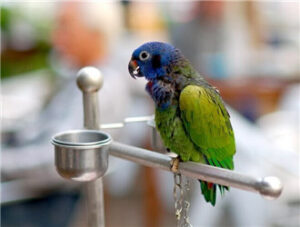
Blue-headed Parrot
The Blue-headed Parrot (Pionus menstruus) is a relatively small, slightly plump parrot with a short tail that can live up to 25 years with good care. It is one of the more commonly kept parrots of its genus, with three subspecies that differ mainly in the depth and spread of the blue coloration on the head.