Search Results
46 results for “one-third change”
How do you keep baby guppies alive?
Separate fry from adults, feed infusoria or brine shrimp after a few days, and do regular partial water changes.
Double-banded Dwarf Cichlid
The double-banded dwarf cichlid was first found in 1906; in the wild it lives among layers of fallen leaves in the rainforest, so keep it with black-water treatment. It is fairly easy to keep, needing only stable water and temperature.

Rosy Barb
The rosy barb is native to India. In the aquarium it reaches 5 to 7 cm, but in the wild it can grow to 14 to 15 cm. During breeding it shows a striking rosy-red nuptial coloration.
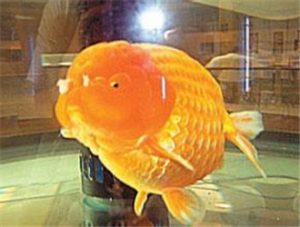
Fuzhou Ranchu Goldfish
Fuzhou Ranchu is a branch of the egg-shaped goldfish distinguished by its well-developed head growth. Originally introduced from Japan, its unique form has made it one of the most popular goldfish varieties today.

Spotted Rasbora
The Spotted Rasbora (Rasbora maculata) is a small, peaceful, omnivorous fish named for the large round black spot on its orange-red body. Best kept in soft acidic water, males show vivid red-black fins while females are paler. It reaches about 2.5 cm.
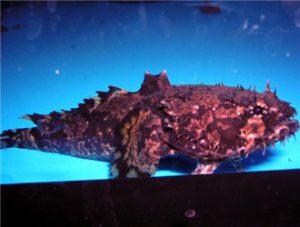
Toadfish
The toadfish shares the same body shape as the lionfish, with an enormous head that can account for up to one-third of its total body length. Also known as the freshwater lionfish, this species is remarkable for its ability to change body coloration to match its surroundings.

Australian Spotted Arowana
The Australian spotted arowana (Scleropages leichardti) — also called the spotted barramundi or northern saratoga — is a large, nocturnal, fiercely aggressive arowana from eastern and northern Australia. A carnivorous tank boss that needs a big aquarium, soft acidic-to-neutral water, and careful, varied feeding.
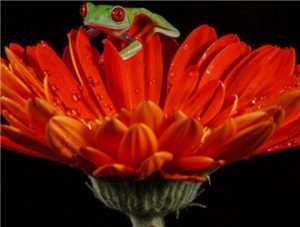
Red-eyed Tree Frog
The iconic big-eyed, green-and-orange hylid of Central American rainforests - fully nocturnal and a live-food specialist. An amphibian, not a reptile.
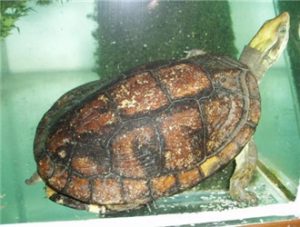
Pan’s Box Turtle
Pan's Box Turtle (Cuora pani) is a small, China-endemic box turtle and a Class II nationally protected species. Rare in the wild and in trade — individual animals can fetch tens of thousands of yuan — it is a prized but legally restricted species that should only be kept where explicitly permitted.

Burmese Black Turtle
The Burmese Black Turtle (Melanochelys trijuga indopeninsularis) is one of the seven subspecies of the Indian black turtle (three-keeled turtle). Common in Chinese pet markets — almost all sourced from wild capture — it is inexpensive but plain-looking, so it is kept in modest numbers.