Burmese Black Turtle
2 Photo Gallery

1 Overview
The Burmese Black Turtle is one of the seven subspecies of the three-keeled turtle (Indian black turtle). It is also common in Chinese flower-and-bird markets, but almost all specimens come from wild-caught individuals. It is cheap, yet its appearance is not especially striking, so relatively few are kept as pets.
Chinese Name: Burmese Black Turtle (缅甸黑山龟)
Latin Name: trijuga
English Name: Burmese Black Turtle (Bengal Black Turtle)
Kingdom: Animalia
Phylum: Chordata
Class: Reptilia
Order: Testudines
Family: Geoemydidae
Genus: Melanochelys
Species: Melanochelys trijuga
Subspecies: Melanochelys trijuga indopeninsularis
Distribution: Widely distributed in Myanmar. Although seen in China, it is not a native Chinese species. Reproduction: oviparous. Habit: semi-aquatic.
2 Physical Characteristics
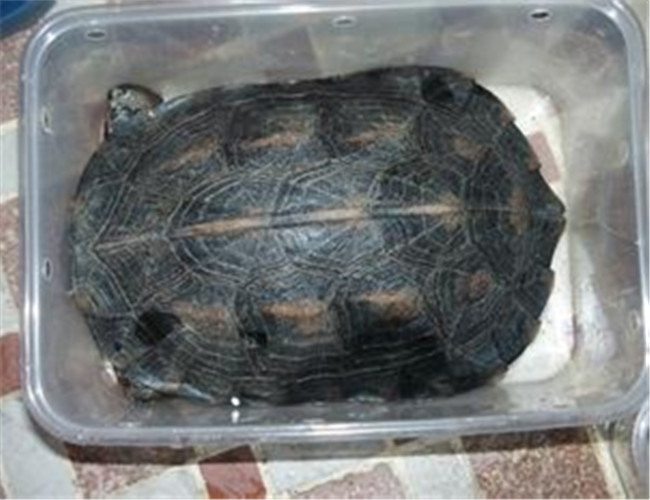
The Burmese Black Turtle has a brownish-red to black, strongly domed carapace with three prominent pale-yellow keels — very eye-catching. The plastron is yellowish-brown with no pattern. The head is brown-black, with an inverted-V marking from the snout to the neck; the limbs and tail are gray-brown.
Head markings are subtle or absent. Black growth lines are visible on the carapace. It is medium-sized with short, black limbs and inconspicuous webbing, giving it only modest swimming ability — suited to shallow water. The plastron is largely black with only a thin yellow gold border around the edges, which stands out clearly.
3 Husbandry
Although the Burmese Black Turtle is an aquatic turtle, its swimming ability is only modest. A substrate of mixed sand and soil helps retain humidity. A water zone can occupy about one-third of the enclosure, or a water dish can substitute; adding driftwood or plants completes the basic setup.
In diet it is omnivorous but leans carnivorous. Hardy and easy to keep, it accepts most standard turtle foods: turtle pellets, small fish and shrimp, dried shrimp, mealworms, crickets, earthworms, and fruits and vegetables.
4 Habitat and Environment
Many keep it, but few truly understand its needs and instead learn by trial and error. Fortunately it is adaptable, so rough keeping rarely causes problems. What is the ideal environment?
Suitable temperature: an easy species, omnivorous, best kept at 18–25°C, with summer temperatures not exceeding 30°C. In winter no heating is needed if room temperature stays around 20°C; below that, artificial heating is advised. It will feed above 16°C but should not drop below 16°C.
Water quality: it is not demanding, but water depth should just cover the carapace; overly deep water risks drowning. At such shallow depths filtration is awkward, so frequent water changes work, and a heater rod or heat lamp can maintain temperature in winter.
5 Feeding
Its food choices are broad. In captivity, after it starts eating, turtle pellets are a good staple, supplemented with some meat and vegetables.
It eats rice, wheat, peas, small fish, shrimp, insects, and snails, with favorites being small fish, snails, corn, and rice. In captivity, to avoid single-diet nutritional deficiencies, offer a varied mix: animal foods such as fish, shrimp, snails, and mussels, and plant foods such as rice, wheat, and corn.
To aid digestion, crush corn and peas and soak them about two hours before feeding; chop other large items. Adjust the feed mix by life stage. Its activity tracks the climate: feeding begins in early April, peaks in June–August when growth is fastest, then declines as temperatures fall in October, and it stops feeding and hibernates below 10°C.