Search Results
1090 results for “fish feeding”
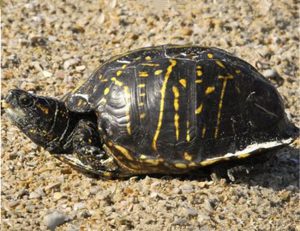
Common Box Turtle
The Carolina box turtle (Terrapene carolina) comprises six subspecies distinguished by their shell patterns and named for its box-like shell. Ranging from eastern North America through Canada and Mexico, this largely terrestrial, omnivorous turtle is exceptionally long-lived, though habitat loss has driven population declines.

Geometric tortoise
The Geometric Tortoise (Psammobates geometricus) is a rare, strikingly patterned South African tortoise protected as endangered. Extremely sensitive to humidity and a challenge to keep alive in captivity, it is best appreciated in the wild or by experts.

Leiocephalus personatus
The Masked Curlytail Lizard (Leiocephalus personatus) is a small, active, territorial lizard from the West Indies, famous for curling its tail like a spring when excited. A hardy basking lover that does well in groups of one male with several females, it eats almost any non-toxic insect.

Three-striped roofed turtle
The giant roofed turtles (including the Burmese, Red-crowned, and Three-striped roofed turtles) are large, rare Asian river turtles that need spacious outdoor ponds with basking sites. Timid yet personable, they require warm water and careful temperature gradients to stay healthy.

Chiapas giant musk turtle
The Chiapas Giant Musk Turtle (Staurotypus triporcatus) is the largest and most vividly patterned of the musk turtles, native to Central America. A highly aquatic, somewhat aggressive omnivore, it needs a large, sturdy, well-filtered aquatic setup.

Lace Monitor
The Lace Monitor (Varanus varius), also called the tree goanna, is a large, arboreal Australian monitor lizard reaching about 1.5 m. An active and nervous climber with a striking spotted pattern, it needs a large, warm, UVB-lit enclosure and a varied diet of eggs, insects, and meat.
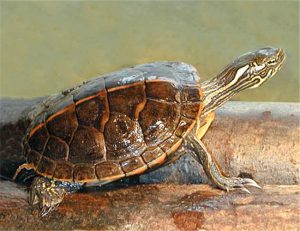
Southern Painted Turtle
The Southern Painted Turtle (Chrysemys picta dorsalis) is the smallest, most strikingly marked subspecies of painted turtle, known for the bold red, orange, or yellow stripe along its carapace midline. Easy to keep and fond of basking, it is omnivorous with a diet shifting from meat as a juvenile to mostly plants as an adult.

Bengal Roof Turtle
The Bengal Roof Turtle (also called the Red-crowned Roof Turtle) is a Critically Endangered Asian river turtle famed for the brilliant red, white, and blue courtship colors of mature males. Rare in captivity and heavily protected, it needs pristine filtered water and warm temperatures, and is mainly herbivorous as an adult.

African Keeled Mud Turtle
The African Keeled Mud Turtle (Pelusios carinatus) is a side-necked turtle from Africa, dark gray to black with a keeled shell and a yellow plastron. A gentle, hardy semi-aquatic species that adapts well to captivity and makes a good, if uncommon, community turtle.
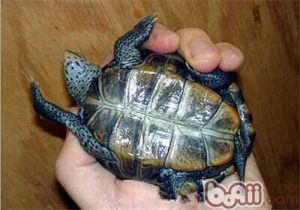
Florida East Coast Diamondback Terrapin
The Florida East Coast Diamondback Terrapin (Malaclemys terrapin) is a dark, subdued brackish-marsh turtle from Florida's Atlantic coast, uncommon in the trade. Unique among turtles, it thrives in brackish water near seawater salinity, so it is best kept in slightly brackish conditions.