Geometric tortoise
2 Photo Gallery
View All 9 Photos


1 Overview
The Geometric Tortoise is a rather fragile species. Although many have tried to keep it, most attempts end in failure. It is also rare and is one of the tortoise species in need of protection.
Also known as the Geometric Turtle, Geometric Sand Turtle, or Geometric Star Tortoise, it is a South African species that can grow up to 6 inches long. Females dig nests in the ground to lay eggs and cover them with vegetation. It is endangered, threatened by habitat loss and hunting for food. Locals steal the eggs to eat and use the shells as decoration, and other mammals also prey on them. The South African government has set aside areas to conserve them.
Chinese Name: Geometric Tortoise
Chinese Alias: Geometric Star Tortoise
English Name: Geometric Tortoise
Binomial Name: Psammobates geometricus
Kingdom: Animalia
Phylum: Chordata
Subphylum: Vertebrata
Class: Reptilia
Order: Testudines
Family: Testudinidae
Species: Geometric Tortoise
Distribution: Western Cape Province, South Africa
Habits: Inhabits dry, sandy savanna. Suitable temperature 18-30 degrees C.
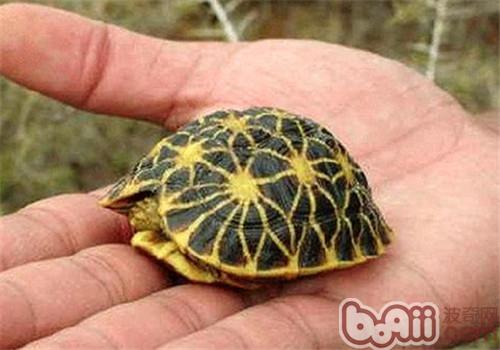
Appearance: The Geometric Star Tortoise’s pattern closely resembles the Indian Star Tortoise; each carapace scute is black-based with yellow stripes radiating from the center, and the scute edges are not serrated. The limbs are mostly yellow, and some individuals have black marks on the head.
Reproduction: Oviparous.
Diet: In the wild it relies on coarse grasses and desert plants.
2 Physical Characteristics
The Geometric Tortoise, also called the Geometric Star Tortoise, has three species in its genus that look similar but differ. Its pattern also resembles the Indian Star Tortoise. So if you like the Geometric Tortoise, the Indian Star Tortoise is suggested as a substitute, since it is more numerous and easier to keep.
1. Appearance of the Geometric Tortoise
The Geometric Tortoise’s pattern closely resembles the Indian Star Tortoise; each carapace scute is black-based with yellow stripes radiating from the center, and the scute edges are not serrated. The limbs are mostly yellow, and some individuals have black marks on the head. The Geometric Tortoise’s carapace edge lacks serrations, distinguishing it from the other two species, which have a wider distribution reaching southwestern Africa.
2. Care of the Geometric Tortoise
At low temperatures the Geometric Tortoise hibernates, but at excessively high temperatures it also estivates, neither eating nor moving. Because South Africa is in the southern hemisphere, its hibernation season is summer in Taiwan. This time difference may be one reason it adapts poorly. Males have a concave plastron and thick tail; females lay 12-15 eggs per clutch, very prolific, with hatchlings about 3 cm long. The Geometric Tortoise is the largest of the three, exceeding 20 cm, while the other two stay under 15 cm.
3 Care Guidelines
The Geometric Tortoise demands a lot from its environment and easily falls ill and dies in captivity, so keeping it is not recommended. People should focus on protecting wild Geometric Tortoises and stop destroying their habitats.
1. Keeping the Geometric Tortoise
Geometric Tortoises can only tolerate warm, dry conditions; in damp environments they easily contract respiratory disease, similar to the Indian Star Tortoise, and the shell can develop shell rot. Use dry sandy substrate. In captivity they rarely survive more than a year, making them a very difficult species, with humidity control being most critical. Among them, only the Tent Tortoise (Psammobates tentorius) adapts reasonably to captivity. In the wild they live on coarse grasses and desert plants, so in captivity feed mainly rough leafy greens or weeds plus cucumbers, radishes, tomatoes, squash, and other produce. At low temperatures they hibernate; at excessively high temperatures they estivate, neither eating nor moving.
2. Soaking the Geometric Tortoise
Soaking prompts the tortoise to urinate (or defecate) immediately, reducing the time urine stays in the body to form uric acid or combine with other organic matter and cause stones. Daily soaking also prevents external parasites from occurring and spreading. Because they get used to defecating in water, they rarely soil their enclosure, which is comparatively hygienic.
Soak for about 10-20 minutes in water roughly half the shell height, at a temperature slightly lower than a human’s bath water. In winter, water cools quickly, so a heat lamp or heater can maintain temperature; in summer, cool water is fine. Dry the tortoise immediately after soaking to avoid chilling.
4 Behavior & Habitat
The Geometric Tortoise’s main environmental need is lighting. Calcium supplementation is difficult, so ample light is essential, and light also helps temperature control. Below is the suitable growing environment.
1. Temperature Requirements
Temperature absolutely affects the Geometric Tortoise’s appetite. Below 18 degrees C it usually stops eating to avoid indigestion. Tortoises and other reptiles are ectothermic; they cannot generate high body heat to digest food and transport nutrients, so they must rely entirely on external sunlight or artificial heat to reach normal temperature before becoming active and feeding. Insufficient temperature causing indigestion or gut impaction is hard to treat. So when winter temperatures fall below 20 degrees C, use heat bulbs, heat mats, or ceramic heaters, which keep both warmth and dryness, but avoid burns.
2. Lighting Needs
The Geometric Tortoise needs long sunlight exposure, as it is native to Africa; UV is vital for vitamin D3 formation, which aids calcium absorption. In captivity, use reptile fluorescent tubes for over ten hours daily or provide direct sunbathing, but always offer shade to prevent dehydration from overexposure. New US-made UVB bulbs combine UV and heat and are ideal. Yet no artificial light replaces sunlight, so regular sunbathing remains essential.
5 Feeding Requirements
The Geometric Tortoise has particular dietary needs; it truly is hard to keep. Its gut is fragile and it needs much calcium, so food choice must be careful.
1. Food Requirements
Three principles for a good diet: 1) high calcium-to-phosphorus ratio; 2) high fiber; 3) low protein. The Geometric Tortoise, especially juveniles, needs abundant calcium for shell and bone growth. Its long digestive tract needs high fiber to promote gut movement and healthy digestion. Long-term feeding of low-fiber supermarket vegetables easily causes sluggish gut motility and degeneration, leading to refusal to eat, dehydration, and death, a main cause of mortality. Animal foods like meat, cat/dog/fish feed, and legumes are high in protein; fed often, they accelerate growth and metabolism, overburdening heart and kidneys, and also cause pyramiding and stones, eventually leading to death.
2. Interactivity
Geometric Tortoise keepers are often frustrated that the tortoise seems unhealthy, sleepy, and inactive, with a temperament unlike others’. In fact the cause lies with the keeper. A tortoise needs time to adapt to a new environment, varying in length. One should proactively help it adjust, spending time with it when free; over time its fear of people lessens, interactivity improves, and it becomes less shy.