Southern Painted Turtle
2 Photo Gallery
View All 7 Photos


1 Overview
The Southern Painted Turtle (Chrysemys picta dorsalis) is the southern subspecies of the painted turtle, often called the ‘southern paint’ in China. Common in the United States, it is easy to keep and has a high survival rate—usually kept much like a Red-eared Slider. The carapace is 10–25 cm, a small aquatic turtle. The smooth, flattened, oval carapace ranges from green to black, with some subspecies showing red markings.
2 Physical Characteristics
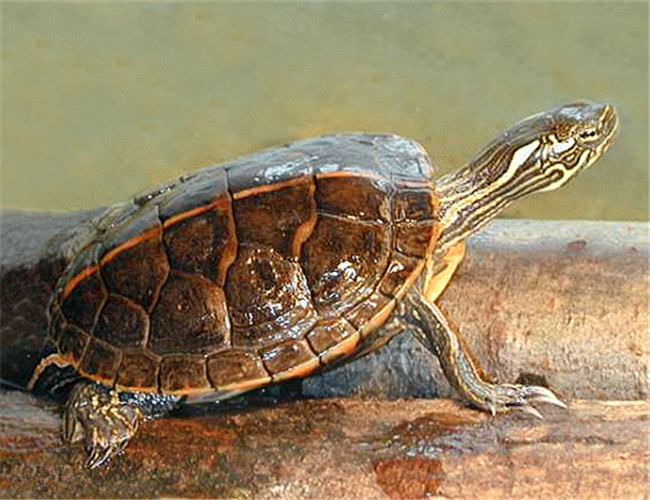
The Southern Painted Turtle’s carapace bears a red stripe—its most defining feature. Also called the southern painted turtle, it has fine red stripes on the carapace and a pale yellow plastron.
It measures about 12.7 cm, with a record of 15.5 cm, the smallest subspecies. Its range runs from southern Illinois and Missouri along the Mississippi south to Louisiana and east to Alabama. Its hallmark is a longitudinal red, orange, or yellow stripe along the carapace midline, quite striking, above a plain yellow plastron.
Behind the eye there is no isolated spot but a white stripe. The center of the head has no stripe. Neck stripes above are pink, below yellow-white; limb stripes are pink. Vertebral and costal scutes alternate normally; the dorsal ridge has a bold yellow-red line—the most distinctive trait separating it from other painted turtles, hence the names red-striped and red-backed turtle. Marginal scute edges are red, extending into a red zone with a gray-black central spot—another distinguishing feature. The plastron is yellow, sometimes with black blotches.
3 Care & Husbandry
The Southern Painted Turtle is easy to keep and inexpensive, but when buying, choose a larger individual—hatchlings are pretty but harder to raise; larger ones have better survival.
1. Behavior & Habitat
It likes ponds, marshes, streams, and lakes with slow flow, soft muddy bottoms, good basking spots, and rich aquatic plants. Diurnal, it sleeps at night on the pond bottom or on partly submerged objects. At sunrise it becomes active, basks for hours, then feeds late morning; it may feed again in the evening.
2. Care
Thanks to its small size and adaptability, it is often kept as a pet. It has a fun personality and does amusing things. It can be kept in a ~4-foot aquarium with UVB lamp, incandescent lamp, heater, filter, rock basking platform and hide, and pebble substrate.
3. Diet
The southern painted turtle’s diet changes with age: plants are 13% of a juvenile’s diet but 88% of an adult’s. This suggests juveniles prefer meat but get it mainly from larvae. The false map turtle sharing its habitat shows a similar age-negative feeding trend. Adults most often eat duckweed and algae, and animals such as dragonfly larvae and crayfish.
4 Natural Habitat
Wild Southern Painted Turtles like ponds, marshes, streams, and lakes with slow flow, soft muddy bottoms, good basking spots, and rich aquatic plants. They love to bask—up to fifty have been seen stacked on one log, and even hatchlings bask. Basking is important: heat keeps proper body temperature, UV removes skin parasites, and it is essential for synthesizing vitamin D3.
5 Care Guidelines
Diet changes with age: younger turtles prefer meat, older ones prefer plants. Many owners feed pellets, a good choice, but ensure variety.
The southern painted turtle’s diet changes with age: plants are 13% of a juvenile’s diet but 88% of an adult’s. This suggests juveniles prefer meat but get it mainly from larvae. The false map turtle sharing its habitat shows a similar age-negative feeding trend. Adults most often eat duckweed and algae, and animals such as dragonfly larvae and crayfish.
The Southern Painted Turtle is omnivorous, eating any plant or animal, dead or alive—snails, slugs, insects, crayfish, tadpoles, small fish, carrion, algae, and aquatic plants. Young are carnivorous; older ones lean herbivorous. They eat aquatic vegetation, algae, and other small aquatic life (insects, crustaceans, fish). Although hatchlings are eaten by rodents, canids, and snakes, the adult’s hard shell defends against most predators except alligators and raccoons.