Search Results
3212 results for “Temperature”

Brown Shrike
The Brown Shrike (Lanius cristatus), also known as the Red-tailed Shrike, Brown Bush Shrike, Tiger Shrike, and Little Shrike, likes moist habitats, feeds on insects, and occasionally eats a little fresh grass. It is mainly distributed across Siberia, from the Irtysh River and Altai east to the Anadyr Basin and Kamchatka Peninsula, as well as Korea, Mongolia, and Japan; in winter it is also seen in India, Indochina, Malaysia, the Philippines, and Indonesia.

Signs a Cockatiel Is Frightened and How to Care for One
Cockatiels are timid and startle easily, reacting with whole-body trembling, restlessness, and cage-bashing. Keep them in a quiet spot, maintain steady temperatures, and feed a mix of corn, sunflower seeds, millet, and cuttlebone for calcium. Comfort and gently stroke the head to calm a frightened bird.

Siberian Chipmunk
The Siberian Chipmunk has the habits of storing food and hibernating; hibernation occurs in the wild, while in warm indoor captivity it does not need to hibernate. Wild chipmunks are mainly distributed in North China, Northwest China, and Northeast China. Their fur is of good quality and attractive.

Chinchilla laniger
The Chinchilla laniger (Chinchilla laniger) is native to the Andes Mountains of South America, where it lives in caves and rock crevices at about 1,600 m elevation. Its appearance resembles that of a rabbit and a squirrel. A special feature is its pair of large, bright, ruby-red eyes, which are beautiful.

Yellow-bibbed Lory
In many places few people keep the Yellow-bibbed Lory, but in the Solomon Islands it is a different story: this is the wild habitat of the Yellow-bibbed Lory, and many locals keep them as pets. Visually the Yellow-bibbed Lory is striking, showing red, yellow, green, and other colors, so many are attracted at first sight. Moreover, the Yellow-bibbed Lory is a strong mimic, whistling is easy for it, yet although it whistles often it never seems noisy.

Zebra Finch
The Zebra Finch, also known as the Pearl bird, is small and exquisite with a charming appearance and a soft, gentle call; its looks are as appealing as its name, and its plumage resembles the color of pearls. China imported it from Australia in the 1970s and 1980s, and has since bred varieties such as camel, white, and pied.

Jardine Parrot
The Jardine Parrot (Poicephalus gulielmi) currently has three subspecies. Its body is almost entirely green and is the second-largest parrot species after the Cape Parrot. Its distribution is scattered and not concentrated, mainly across central Africa and parts of West Africa.
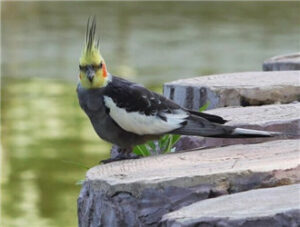
Cockatiel
The Cockatiel (Cockatiel) goes by different names in different regions; in Hong Kong and Taiwan it is often called the Crested Parrot. The Cockatiel is one of the most common medium-sized parrots in the world. Hand-reared young birds are very lively and love to bond with their owners.

Serinus canaria
The Canary (Serinus canaria) is prized for its beautiful, varied plumage and sweet, melodious song, and is regarded in China as one of the most elegant cage birds. Wild canaries differ noticeably in color from captive-bred ones.

Rhesus Macaque
The Rhesus Macaque (Macaca mulatta), also called the yellow monkey, rhesus monkey, or Guangxi monkey, is a primate physiologically very close to humans and easy to domesticate and breed. However, because many monkeys are now protected species, keeping a rhesus macaque as a pet has become a major challenge.