Piranha
2 Photo Gallery

1 Species Overview
The piranha is a general name for a group of fish native to the Amazon River in South America; it is also translated as the ‘water tiger fish’ (水虎鱼). In fact the piranha is a group comprising nearly 30 species, which can be divided into herbivorous and carnivorous types according to their feeding habits and behavior.
Chinese name: Piranha (食人鲳)
Scientific name: Serrasalmus nattereri / Pygocentrus nattereri
Body length: 200–300 mm
Water hardness: soft water
Temperament: fierce and aggressive
Other names: man-eating fish, water tiger fish
Taxonomy: order Characiformes, family Characidae, genus Serrasalmus (锯脂鲤属)
Water temperature: 22–28 °C
pH: weakly acidic
Feeding habit: animal-based foods
2 Appearance
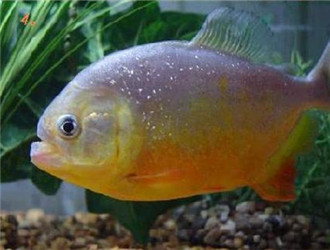
Usually, when people say ‘piranha’ they mean the carnivorous red-bellied piranha (Pygocentrus nattereri). This piranha is typically ferocious and can even attack humans. Its coloration also varies with the habitat it lives in.
The piranha has red eyes and an oval, laterally compressed body with a forked caudal fin. The body is grey-green, the back dark green, and the belly bright red. Its teeth are sharp, the lower jaw is well developed and spiny, and it is famous for its ferocity. Sexing is fairly difficult: males are generally more vividly colored and smaller, while females are larger, paler, and swell in the belly when sexually mature.
Adult piranhas of both sexes look alike, with a bright green back and bright red belly and streaks along the flanks. They have highly developed hearing. The jaws are short but powerful, the lower jaw protrudes, and the teeth are sharp triangles arranged in interlocking upper and lower rows. Once they seize prey they hold on tight and twist their bodies to tear off flesh—a single bite can remove 16 cubic centimeters of meat. Their teeth are replaced in rotation so they can keep feeding, and the powerful dentition can cause severe bite wounds.
Species found in China include Serrasalmus geryi and Serrasalmus nattereri. Both have an oval body and forked caudal fin; adults are usually around 25 cm long, grey-green in color with a dark-green back and bright-red belly. The lower jaw is well developed and spiny, and the teeth are sharp, triangular and arranged like a saw.
3 Tank & Habitat
The piranha is often used as a metaphor for a cruel, inhuman person. Its teeth are extremely sharp and a single bite can take 16 cubic centimeters of flesh. So what water-quality and environmental points should you watch if you want to keep piranhas in captivity?
Piranhas are not demanding about water quality; they prefer weakly acidic soft water and grow best at 22–28 °C. They feed in groups and prey mainly on smaller fish, attacking anything that moves in the water. They are especially sensitive to the smell of blood—even a trace can trigger a frenzied attack by a whole school. Piranhas are robust and easy to keep, but must not be housed with other fish. In the wild they live in main channels and large tributaries—wide rivers with fairly fast currents. Adults feed mainly at dawn and dusk on insects, worms and fish, though some close relatives eat only fruit and seeds. They are active during the day and rest in cover at noon.
4 Feeding
Because piranhas pose a serious threat to China’s ecosystem and to other ornamental fish, and can easily injure people, private keeping is not recommended, nor is releasing them into the wild. But if kept in captivity, what should they be fed?
Piranhas have highly developed hearing and exceptionally sharp teeth. Once they seize prey they hold on and twist to strip the flesh; a single bite removes 16 cubic centimeters of meat, and the rotating tooth replacement lets them keep feeding while the strong dentition causes severe wounds. They prefer meat; keep the water at 25–30 °C. They are not fussy about water quality. If you no longer want your piranha, give it to someone else rather than releasing it—piranhas reproduce explosively, and once in open water they can cause injury incidents.